---
title: "Collaborative Leadership: Lay Leaders vs. Staff"
description: "Balanced synagogue leadership depends on clear role boundaries: boards set vision, staff manage operations, and both must collaborate."
image: https://assets.seobotai.com/cdn-cgi/image/quality=75,w=1536,h=1024/easyshul.com/69c5ce071b352ff267cc374e-1774581441243.jpg
---
[Skip to content](https://blog.easyshul.com/blog/collaborative-leadership-lay-leaders-vs-staff#main-content)
.png?width=3750&height=938&name=Easyshul%20Logo%20(1).png)
Open main navigation
Close main navigation
- [Book a Demo](https://easyshul.com/form.html)
[Book a Demo](https://easyshul.com/form.html)
Apr 12, 2026 1:26:28 PM
# Collaborative Leadership: Lay Leaders vs. Staff
[Easyshul](https://blog.easyshul.com/blog/author/easyshul)
Share: [facebook-f icon](http://www.facebook.com/share.php?u=https://blog.easyshul.com/blog/collaborative-leadership-lay-leaders-vs-staff) [linkedin-in icon](http://www.linkedin.com/shareArticle?mini=true&url=https://blog.easyshul.com/blog/collaborative-leadership-lay-leaders-vs-staff) [Twitter icon](https://twitter.com/intent/tweet?url=https://blog.easyshul.com/blog/collaborative-leadership-lay-leaders-vs-staff) [envelope icon](mailto:?body=https://blog.easyshul.com/blog/collaborative-leadership-lay-leaders-vs-staff)
**Synagogue leadership thrives on a clear partnership between lay leaders and staff.** Lay leaders focus on vision and governance, while staff handle daily operations and execution. When roles are well-defined, this collaboration ensures smooth functioning and a united community. However, blurred boundaries can lead to inefficiencies, conflicts, and burnout.
### Key Takeaways:
- **Lay Leaders**: Shape long-term vision, set policies, and provide strategic oversight.
- **Staff Professionals**: Manage daily tasks, ensure continuity, and implement board policies.
- **Challenges**: Role confusion, micromanagement, and conflicting directives hinder collaboration.
- **Solutions**: Define roles clearly, establish a single chain of command, and use tools like [Easyshul](https://easyshul.com/) for efficiency.
By respecting each role and fostering communication, synagogues can create a balanced leadership model that benefits everyone.
## 1. Lay Leaders
### Roles and Responsibilities
Lay leaders - such as board members, trustees, and committee chairs - serve as volunteer governors, helping to shape the congregation's long-term vision. Their duties include policy-making, stewardship, sponsorship, advocacy, and offering guidance when needed. They play a key role in setting employment policies, determining compensation standards, and safeguarding the community's moral and intangible assets.
However, their role is not to oversee daily operations. As Stefan Jonasson explains, board members act as consultants to staff, sharing their professional expertise - whether in legal, corporate, or therapeutic fields - when staff requests their input.
### Strengths
Lay leaders bring a wealth of experience from their secular careers, offering skills that complement the expertise of staff. For example, at [Temple Emanu-El](https://www.tedallas.org/) in Dallas, the diverse professional backgrounds of lay leaders enhance both operational logistics and broader strategic initiatives. Their active involvement in the community, along with their financial and personal support, fosters a sense of shared commitment and engagement among peers.
### Challenges
One of the biggest challenges lay leaders face is maintaining clear boundaries between their governance role and the day-to-day management of the congregation. This overlap can lead to boards unintentionally stepping into operational matters rather than focusing on strategic oversight.
> "The most dangerous thing a board can do... is seek to supervise the daily work of the minister".
As congregations expand, boards must adapt by shifting their focus from hands-on tasks to a more strategic governance role. Another issue arises when individual board members prioritize personal agendas or withhold critical information during conflicts. Such actions can damage the trust and collaboration needed for effective leadership.
Next, we’ll look at how staff professionals work alongside lay leaders to create a balanced and effective leadership dynamic.
###### sbb-itb-549ca3a
## 2. Staff Professionals
### Roles and Responsibilities
Staff professionals, including Executive Directors and Senior Clergy, play a critical role in ensuring the smooth daily operations of a synagogue. Their duties range from managing finances and producing membership materials to maintaining websites and organizing events for major occasions like the High Holidays. They also oversee support staff and ensure the implementation of board policies. Larry Glickman from the [Union for Reform Judaism](https://urj.org/) aptly describes their role:
> "Working in sacred partnership with clergy, staff and lay leaders, the executive director shall oversee the day-to-day operations of the synagogue. All the rest is commentary, now go and get to work."
Unlike lay leaders who rotate in and out, staff professionals provide continuity. They act as a bridge between the governing board and the congregation, managing long-term cycles such as membership renewals, holiday preparations, and strategic planning. This consistency is key to maintaining the synagogue’s stability and progress.
### Strengths
Staff professionals bring a level of expertise and focus that volunteers often cannot match. Their specialized training and full-time commitment are especially crucial for congregations with more than 150 members, where administrative complexity increases. They handle tasks like financial management, educational programming, and operational logistics with efficiency and precision.
Because they are consistently present, staff professionals often become the synagogue’s go-to representatives. Whether it’s engaging children during services, directing traffic, or supporting community members in times of need, their constant involvement fosters a sense of stability and reliability, even as lay leadership changes over time.
### Challenges
One of the significant challenges staff professionals face is navigating the demands of "multiple bosses." Lay leaders often provide conflicting directions, creating confusion and inefficiency. Rabbi Joshua C. Lesser highlights this issue:
> "When boards move into management, two things happen: Staff leadership weakens. Trustees slowly exhaust themselves trying to run an organization they were never meant to operate."
Frequent turnover among board members further complicates matters. Each new board often brings its own assumptions and expectations, making it difficult for staff to adjust and maintain consistency. During times of conflict, there’s a risk of miscommunication or withholding information, which can erode trust and hinder effective governance.
Another layer of complexity arises when clergy serve dual roles as spiritual leaders and governance participants. This dual function can blur boundaries, making it harder for board members to provide objective feedback on leadership. Addressing these challenges requires clear strategies for collaboration, which will be explored in the following section.
## Exploring Pastoral Leadership Models: Collaborative Leadership
## Comparing Strengths and Challenges
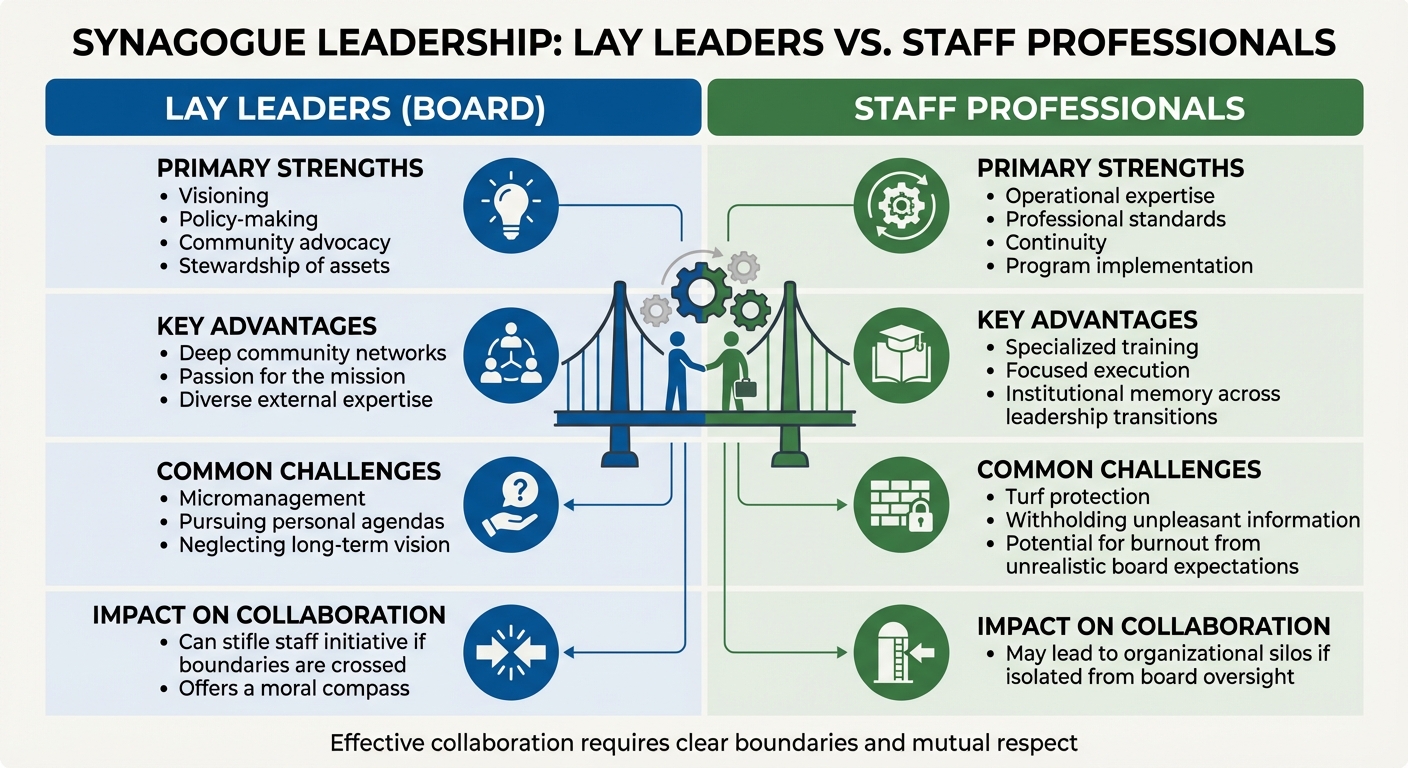
Lay Leaders vs Staff Professionals: Roles, Strengths and Challenges in Synagogue Leadership
Understanding the distinct strengths and challenges of lay leaders and staff professionals sheds light on the importance of deliberate collaboration. The table below outlines how these two groups complement each other while navigating their unique pressures.
| Feature | Lay Leaders (Board) | Staff Professionals |
| --- | --- | --- |
| **Primary Strengths** | Visioning, policy-making, community advocacy, and stewardship of assets | Operational expertise, professional standards, continuity, and program implementation |
| **Key Advantages** | Deep community networks, passion for the mission, and diverse external expertise | Specialized training, focused execution, and institutional memory across leadership transitions |
| **Common Challenges** | Micromanagement, pursuing personal agendas, and neglecting long-term vision | Turf protection, withholding unpleasant information, and potential for burnout from unrealistic board expectations |
| **Impact on Collaboration** | Can stifle staff initiative if boundaries are crossed while also offering a moral compass | May lead to organizational silos if there is isolation from board oversight |
Lay leaders bring passion and an external viewpoint, often leveraging their strong community ties to inspire organic growth. For example, a congregant might start informal music sessions that attract new families, showcasing the power of grassroots initiatives. On the other hand, staff professionals ensure smooth operations through their specialized expertise and steady presence, which is critical for maintaining continuity. However, without clear and coordinated input from the board, staff may encounter conflicting directives.
As Stefan Jonasson aptly points out:
> It is a responsibility of the board as a whole to protect the staff from board members acting on their own personal agendas.
The real challenge lies in building a structure where both groups can excel within their roles. Recognizing these dynamics is key to establishing frameworks that encourage effective collaboration - a topic we'll dive into in the next section.
## How to Build Effective Collaboration
Effective collaboration doesn't just happen - it requires deliberate effort and clear strategies. By addressing challenges head-on and leveraging each group's strengths, you can create a system where everyone works in harmony toward shared goals.
A great starting point is to rethink how meetings are structured. Instead of spending valuable time on routine operational updates, prioritize discussions around strategic, forward-looking topics. Rabbi Joshua C. Lesser succinctly puts it:
> Healthy governance rests on a simple distinction: Boards govern. Staff manage.
When meetings focus too much on immediate tasks, they can lose sight of the bigger picture. Shifting the agenda ensures that strategic vision takes center stage.
Another key practice is establishing a *single chain of command*. The board should direct only the senior staff leader - whether that's the Rabbi or Executive Director - who then oversees the rest of the team. This approach eliminates conflicting instructions and reduces the risk of burnout. Board members should avoid giving direct orders to staff and instead act as advisors when their expertise is requested.
Technology can also play a big role in improving collaboration. Platforms like Easyshul (https://easyshul.com) simplify operations by centralizing data and automating tasks. For example, Easyshul can handle everything from yahrzeit reminders to online payment processing. This not only reduces micromanagement but also gives both board and staff real-time access to crucial information. When combined with clear policies, technology can greatly enhance teamwork and efficiency.
After creating a solid structure, it’s important to keep evaluating and fine-tuning it. Quarterly mutual evaluations offer a chance to address friction points early, ensuring the system continues to operate smoothly. The Union for Reform Judaism highlights the importance of this ongoing effort, noting that synagogues:
> are most successful when lay leaders, professional staff, and clergy work together in the spirit of Jewish teachings and traditions.
Collaboration thrives when it's nurtured consistently - not just at the start, but throughout the journey.
| Method | Description | Expected Result |
| --- | --- | --- |
| **Flipping the Agenda** | Begin meetings with strategic discussions | Keeps focus on long-term goals instead of routine updates |
| **Single Leadership Chain** | Board oversees senior staff leader, not all staff | Provides clear, consistent direction |
| **Operational Technology** | Use Easyshul to streamline synagogue management | Reduces micromanagement and improves efficiency |
| **Policy-Based Governance** | Clear policies empower staff to act independently | Encourages autonomy while maintaining accountability |
| **Mutual Evaluation** | Regular check-ins on leadership collaboration | Builds trust and resolves issues proactively |
## Conclusion
The success of a synagogue often hinges on embracing a shared leadership model. When lay leaders and professional staff collaborate with mutual respect and well-defined boundaries, they create a powerful synergy that elevates everyone involved. As Lisa Lieberman Barzilai aptly states, "Sacred partnerships recognize each of us as individuals working toward shared goals". Relying solely on one leader can limit the potential of the entire community. By working together, synagogues not only strengthen governance but also create opportunities for sustainable growth.
Creating this collaborative model requires clear role definitions, open lines of communication, and a foundation rooted in Jewish values like *tikkun olam*. Stefan Jonasson highlights the importance of leadership qualities in this process:
> mature and faithful people can make almost any organizational structure work, whereas the best structure will crumble if it is led by individuals lacking in personal maturity and the gifts of leadership.
In this partnership, the board brings vision, policy expertise, and a community-focused perspective, while the professional staff contributes operational experience and execution. By combining these strengths and fostering transparent communication, synagogues can achieve solutions that might not have been possible otherwise. This approach offers long-term benefits, enhancing the synagogue's ability to serve its members and fulfill its sacred mission.
Start small - implement one or two strategies and expand as progress is made. Keep an eye on the results, make adjustments, and build on the successes you achieve. Collaborative leadership is not a one-time goal but an ongoing practice that evolves over time.
To support these efforts, synagogues can explore tools like Easyshul (https://easyshul.com), which provides resources for communication, membership management, and operational efficiency. These tools empower congregations to put collaborative strategies into action effectively and efficiently.
## FAQs
### Who should make the final call when board and staff disagree?
When disagreements occur between the board and staff, the governing board usually has the final say. This is because they hold responsibility for oversight and fiduciary obligations. That said, adopting a collaborative approach to decision-making can go a long way in promoting alignment and fostering mutual understanding.
### How can a board stay strategic without micromanaging staff?
To keep a board focused on strategy, it's crucial to establish clear roles and boundaries. The board should prioritize governance and long-term planning, leaving the day-to-day operations to the staff. This separation allows everyone to focus on what they do best without stepping on each other's toes.
Regular meetings dedicated to strategic discussions are key. These sessions help ensure that the board stays aligned on the organization's vision and priorities, offering oversight without veering into micromanagement.
Trust and open communication are just as important. When the board and staff maintain a strong, transparent relationship, it creates an environment where the board can provide guidance effectively, while the staff focuses on executing the organization's mission.
### What’s the best way to set a clear chain of command?
To create a clear chain of command, start by building an organizational structure that clearly defines roles and responsibilities. This structure should also promote teamwork and open communication. Tools like **organizational charts** can help map out the relationships between the board and staff, ensuring everyone understands their place and duties. At the same time, leadership roles should be clearly outlined but flexible enough to support collaboration and adaptability within the team.
## Related posts
[](https://blog.easyshul.com/blog/reengaging-lapsed-synagogue-members-checklist)
## [Checklist for Re-engaging Lapsed Synagogue Members](https://blog.easyshul.com/blog/reengaging-lapsed-synagogue-members-checklist)
[Easyshul](https://blog.easyshul.com/blog/author/easyshul)
Jun 10, 2026 2:22:35 AM
Did you know? Nearly 50% of North American Jews leave their synagogue within 3–5 years of joining....
[Read more](https://blog.easyshul.com/blog/reengaging-lapsed-synagogue-members-checklist)
[](https://blog.easyshul.com/blog/synagogue-communication-tools-complete-guide)
## [The Complete Guide to Synagogue Communication Tools](https://blog.easyshul.com/blog/synagogue-communication-tools-complete-guide)
[Easyshul](https://blog.easyshul.com/blog/author/easyshul)
Mar 2, 2026 12:46:55 AM
Managing synagogue communication can be challenging, but modern tools can streamline the process...
[Read more](https://blog.easyshul.com/blog/synagogue-communication-tools-complete-guide)
[](https://blog.easyshul.com/blog/from-attendance-to-belonging-boosting-synagogue-engagement-with-easyshul)
## [From Attendance to Belonging: Boosting Synagogue Engagement with Easyshul](https://blog.easyshul.com/blog/from-attendance-to-belonging-boosting-synagogue-engagement-with-easyshul)
[Easyshul](https://blog.easyshul.com/blog/author/easyshul)
Sep 8, 2025 4:14:28 AM
How Easyshul Helps Synagogues Increase Engagement with Modern Tools In today’s fast-paced world,...
[Read more](https://blog.easyshul.com/blog/from-attendance-to-belonging-boosting-synagogue-engagement-with-easyshul)
[linkedin-in icon](https://www.linkedin.com/company/easyshul) [Follow us on Facebook](https://easyshul.com/)
---
447 Broadway Suite #672, New York, NY 10013, United States
[Shalom@easyshul.com](mailto:Shalom@easyshul.com) (866) 215-5950
Copyright © 2024, Easyshul Inc
```json
{
"@context" : "https://schema.org",
"@type" : "BlogPosting",
"author" : {
"@type" : "Person",
"name" : "Easyshul",
"url" : "https://blog.easyshul.com/blog/author/easyshul"
},
"dateModified" : "2026-04-12T17:26:28.296Z",
"datePublished" : "2026-04-12T17:26:28.000Z",
"headline" : "Collaborative Leadership: Lay Leaders vs. Staff",
"image" : [ "https://assets.seobotai.com/cdn-cgi/image/quality=75,w=1536,h=1024/easyshul.com/69c5ce071b352ff267cc374e-1774581441243.jpg" ],
"mainEntityOfPage" : {
"@id" : "https://blog.easyshul.com/blog/collaborative-leadership-lay-leaders-vs-staff",
"@type" : "WebPage"
},
"publisher" : {
"@type" : "Organization",
"logo" : {
"@type" : "ImageObject",
"url" : "https://blog.easyshul.com/hubfs/Untitled%20design%20(96).png"
},
"name" : "Easyshul Inc"
}
}
```
```json
{
"@context" : "https://schema.org",
"@type" : "FAQPage",
"mainEntity" : [ {
"@type" : "Question",
"acceptedAnswer" : {
"@type" : "Answer",
"text" : "When disagreements occur between the board and staff, the governing board usually has the final say. This is because they hold responsibility for oversight and fiduciary obligations. That said, adopting a collaborative approach to decision-making can go a long way in promoting alignment and fostering mutual understanding.
"
},
"name" : "Who should make the final call when board and staff disagree?"
}, {
"@type" : "Question",
"acceptedAnswer" : {
"@type" : "Answer",
"text" : "To keep a board focused on strategy, it's crucial to establish clear roles and boundaries. The board should prioritize governance and long-term planning, leaving the day-to-day operations to the staff. This separation allows everyone to focus on what they do best without stepping on each other's toes.
Regular meetings dedicated to strategic discussions are key. These sessions help ensure that the board stays aligned on the organization's vision and priorities, offering oversight without veering into micromanagement.
Trust and open communication are just as important. When the board and staff maintain a strong, transparent relationship, it creates an environment where the board can provide guidance effectively, while the staff focuses on executing the organization's mission.
"
},
"name" : "How can a board stay strategic without micromanaging staff?"
}, {
"@type" : "Question",
"acceptedAnswer" : {
"@type" : "Answer",
"text" : "To create a clear chain of command, start by building an organizational structure that clearly defines roles and responsibilities. This structure should also promote teamwork and open communication. Tools like organizational charts can help map out the relationships between the board and staff, ensuring everyone understands their place and duties. At the same time, leadership roles should be clearly outlined but flexible enough to support collaboration and adaptability within the team.
"
},
"name" : "What’s the best way to set a clear chain of command?"
} ]
}
```