---
title: The Complete Guide to Synagogue Communication Tools
description: How to use email, SMS, and member portals to streamline synagogue updates, event coordination, and yahrzeit tracking for better member engagement.
image: https://assets.seobotai.com/cdn-cgi/image/quality=75,w=1536,h=1024/easyshul.com/69a4ddd612de151ab0265e72-1772430512206.jpg
---
[Skip to content](https://blog.easyshul.com/blog/synagogue-communication-tools-complete-guide#main-content)
.png?width=3750&height=938&name=Easyshul%20Logo%20(1).png)
Open main navigation
Close main navigation
- [Book a Demo](https://easyshul.com/form.html)
[Book a Demo](https://easyshul.com/form.html)
Mar 2, 2026 12:46:55 AM
# The Complete Guide to Synagogue Communication Tools
[Easyshul](https://blog.easyshul.com/blog/author/easyshul)
Share: [facebook-f icon](http://www.facebook.com/share.php?u=https://blog.easyshul.com/blog/synagogue-communication-tools-complete-guide) [linkedin-in icon](http://www.linkedin.com/shareArticle?mini=true&url=https://blog.easyshul.com/blog/synagogue-communication-tools-complete-guide) [Twitter icon](https://twitter.com/intent/tweet?url=https://blog.easyshul.com/blog/synagogue-communication-tools-complete-guide) [envelope icon](mailto:?body=https://blog.easyshul.com/blog/synagogue-communication-tools-complete-guide)
Managing synagogue communication can be challenging, but modern tools can streamline the process and improve connections with members. This guide explores how to simplify tasks like sending updates, managing events, and tracking yahrzeits using centralized platforms. Key takeaways:
- **Text messaging** is effective for urgent updates, with 98% of SMS read within 3 minutes.
- **Email tools** with segmentation and automation help target specific groups like school families or board members.
- **Member portals** allow congregants to manage profiles, payments, and event registrations.
- Specialized features like Hebrew text support, yahrzeit tracking, and High Holiday planning cater to Jewish-specific needs.
## Get to know [Easyshul](https://easyshul.com/)
###### sbb-itb-549ca3a
## Understanding Your Synagogue's Communication Needs
To effectively communicate within your synagogue, it's crucial to identify your audiences and address their specific needs. Synagogues serve a diverse group of individuals, each with unique expectations. For instance, board members may prioritize tools for quick coordination, while families often seek timely updates about religious school activities. Seniors, on the other hand, tend to appreciate clear and straightforward messaging. Breaking your congregation into distinct segments is a vital step in crafting targeted and meaningful communication.
### Who You Need to Communicate With
Your synagogue likely interacts with several key groups, each requiring tailored messaging:
- **Active members**: They expect regular updates on services, events, and lifecycle celebrations.
- **Board members and volunteers**: These individuals often need private, secure communication channels for collaboration, such as video conferencing or messaging tools.
- **Religious school families**: Parents value consistent updates on schedules, curriculum changes, and holiday programming.
- **Prospective members**: First impressions often come from your synagogue's digital presence, which is critical given that 69% of the public uses social media.
Don’t overlook less obvious groups. A National Rabbinic Survey revealed that 92% of rabbis acknowledge the importance of reaching interfaith couples, singles, single parents, etc.
While identifying these audiences is a necessary first step, many synagogues struggle with systemic barriers that hinder effective communication.
### Common Communication Problems
One of the biggest challenges synagogues face is fragmented systems. When membership data, emails, and event registrations are managed separately, it slows down urgent messaging. This can lead to frustrating scenarios, like struggling to find a tenth person for a minyan in time. Families may also feel overwhelmed when bombarded with multiple, uncoordinated messages - such as receiving seven different texts for various appointments.
Generational differences further complicate communication. Younger members might prefer digital tools like social media or apps, while older members often favor phone calls or printed materials. Additionally, transactional messages - like billing statements - can sometimes feel impersonal, lacking the warmth and spiritual connection that members seek.
### Defining Your Communication Goals
To address these challenges, start by setting clear communication goals informed by your audience insights. A communication audit can help identify what’s working and where improvements are needed. For example, analyze whether emails are being opened or if members are attending events they’ve been invited to. Metrics like open rates, response rates, and attendance figures are invaluable for tracking engagement.
Avoid generic messaging. Instead, segment your audience and tailor communications to their specific needs. For instance, messages for youth programs should differ from those aimed at senior members. Planning is also key - create a communications calendar that works backward from major holidays like the High Holidays or Passover. Define measurable goals, whether it’s increasing Shabbat attendance, streamlining administrative tasks, or fostering stronger connections among members.
## Core Features to Look for in Communication Tools
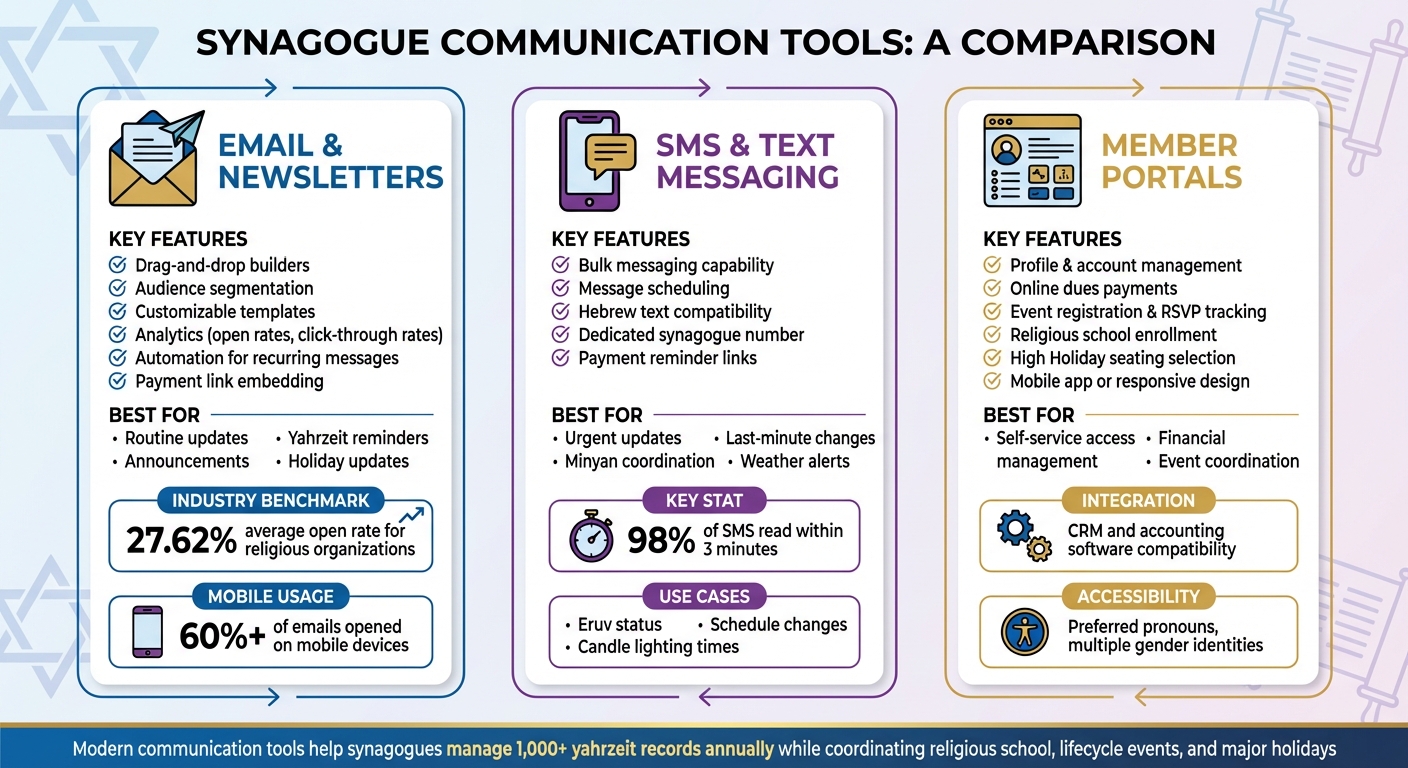
Synagogue Communication Tools: Features and Benefits Comparison
Once you’ve outlined your communication goals, the next step is to identify features that simplify workflows and cater to your synagogue’s unique needs. From organizing daily minyanim to coordinating High Holiday logistics, the right tools can make a world of difference.
### Email and Newsletter Functions
Email remains a cornerstone of synagogue communication. Look for tools with **drag-and-drop builders** and customizable templates to create polished announcements. **Audience segmentation** is another must-have feature - it allows you to target specific groups like daily minyan attendees, religious school parents, or board members, ensuring everyone gets information relevant to them. Analytics for open rates, click-through rates, and automation for recurring messages (like yahrzeit reminders or holiday updates) are also critical. Personalization features, such as embedding payment links for dues or donations, can further enhance member engagement.
Amber Giddings, Executive Director at [Temple Beth Sholom](https://templebethsholomfl.org/), highlights the importance of flexibility:
> "What made me feel confident about choosing Easyshul was knowing it had everything I needed. They truly listen to customer feedback and adapt the platform to users' needs - which is vital."
While email handles routine updates, SMS is key for urgent, time-sensitive communication.
### SMS and Text Messaging
Text messaging serves as a fast and reliable way to deliver urgent updates. Whether it’s coordinating a minyan, announcing last-minute shiur changes, or sending weather-related alerts, SMS ensures critical information reaches members instantly. Look for tools that support bulk messaging, scheduling for planned reminders (like Rosh Chodesh or candle lighting times), and Hebrew text compatibility for traditional communications. Using a dedicated synagogue number also helps members recognize and trust the source. Additionally, SMS can simplify financial tasks by sending reminders for outstanding balances with direct payment links.
While SMS is great for quick updates, member portals provide a more comprehensive, self-service communication hub.
### Member Portals for Direct Access
A well-designed member portal gives congregants the ability to manage their profiles, accounts, and payments with ease. Key features include:
- **Account Management:** Options for updating profiles, linking family accounts, setting communication preferences, and managing lifecycle events like yahrzeit observances.
- **Financial Tools:** Online dues payments, recurring donation setups, and access to tax receipts.
- **Educational Tools:** Enrollment for religious school, class management, and registration for adult education programs.
- **Event Management:** Tools for tracking RSVPs and selecting High Holiday seating.
Mobile compatibility is essential, whether through a dedicated app or a mobile-responsive site. Integration with your CRM and accounting software is equally important to ensure data consistency. Modern portals also accommodate diverse family structures by allowing members to set preferred pronouns and multiple gender identities.
Renee Delafranconi, Executive Director at [Temple Emanu El](https://emanuelnyc.org/), shares her positive experience:
> "The migration was seamless for us. Easyshul's onboarding process was wonderful - we felt fully supported every step of the way. The system was simple to learn and truly user-friendly."
## Communication Tools for Synagogue-Specific Operations
Synagogues have unique communication needs that go beyond standard email and messaging platforms. From managing yahrzeit observances to coordinating High Holiday logistics, these institutions require tools tailored to the rhythms of Jewish life. For example, the average synagogue oversees more than 1,000 yahrzeit records annually while also juggling religious school schedules, lifecycle events, and major holidays. Specialized communication tools integrate seamlessly with core platforms, ensuring these responsibilities are handled efficiently.
### Lifecycle Event and Yahrzeit Reminders
Managing yahrzeits effectively requires systems that can automatically convert dates between the Gregorian and Hebrew calendars, accounting for differences like leap years. These tools ensure reminders are sent on time, whether via email, SMS, print mail, or even WhatsApp, depending on members’ preferences \[13, 14, 15\]. Self-service portals further simplify the process, allowing congregants to update yahrzeit records, view upcoming observances, and make donations online \[13, 14\].
For gabbaim, detailed reports highlight members with upcoming yahrzeits, making it easier to offer honors during services \[11, 13\]. Pastoral care modules take lifecycle communication a step further, enabling clergy and staff to track critical moments like births, illnesses, hospitalizations, and bereavements in a centralized system. These tools also automate follow-up tasks and share real-time updates with care committees, ensuring families receive the support they need \[1, 11\]. Advanced systems even link a single deceased record to multiple family members, preventing duplicate entries while notifying all relevant individuals. Beyond these reminders, specialized platforms also streamline planning for major events like the High Holidays.
### High Holiday and Event Coordination
High Holiday preparations bring their own set of challenges, from seating arrangements to ticketing and member communications. Online seating tools let members choose their seats, note preferences (like aisle access or sitting near friends), select ticket tiers based on membership status, and pay instantly. This self-service approach not only reduces administrative workloads but also gives families more control over their experience.
Targeted communication plays a key role here. Segmented outreach allows synagogues to send tailored messages to different groups - like families with young children receiving information about youth services or seniors getting updates on accessible seating options \[11, 18\]. For other events, systems should enable staff to quickly set up event details, manage attendee preferences, and collect payments all in one place \[1, 19\]. SMS remains an essential tool for urgent updates, such as eruv status changes, schedule adjustments, or weather-related service cancellations \[11, 18\].
### Religious School and Education Updates
Education communication tools are another vital part of synagogue operations. Unified enrollment systems simplify the registration process, allowing families to sign up multiple children for programs like preschool, religious school, adult education, or camp in one streamlined step. These tools integrate email and SMS notifications to keep parents informed about schedule changes, classroom updates, or emergencies.
Features like class and teacher placement, automated tuition billing with recurring payments, and attendance tracking free up educators to focus on teaching rather than administrative tasks. Mobile accessibility is a must, enabling parents to update information, check schedules, and receive alerts directly from their phones via a dedicated app or mobile-responsive portal. Ad-hoc reporting tools provide instant access to student data, enrollment figures, and financial details, helping administrators make informed decisions. With the rise of cloud-based systems, staff and volunteers can access school data from any device, ensuring smooth coordination between the office, classrooms, and families at home.
## How to Implement and Improve Your Communication Tools
Once you've identified the essential communication tools for your synagogue, the next step is implementing them effectively and ensuring they work seamlessly for your community.
### Choosing the Right Tools for Your Synagogue
Start by defining clear goals for your communication tools. Are you aiming to boost event registrations, increase donation responses, or encourage more volunteer participation? Setting specific targets is crucial, especially when religious organizations already enjoy an impressive average email open rate of 27.62% - one of the highest across industries.
Budget and functionality are key considerations. Pricing can vary widely, from $72 per month for smaller congregations (up to 125 families) to $370 for more feature-rich systems. For example, **Easyshul** provides an all-in-one platform for $349/month for congregations with over 150 families, while offering custom pricing for smaller groups. To get the most out of your system, organize your contact lists by categories like membership status, committees, or specific interests (e.g., sisterhood groups or minyan teams) before comparing costs.
Another must-have? Mobile compatibility. With over 60% of emails now opened on mobile devices, any platform you choose needs to function effortlessly on phones and tablets. Once you've selected the right tool, the focus shifts to equipping your team to use it effectively.
### Training Staff and Encouraging Adoption
From the outset, establish clear guidelines for your communication strategy. Define who can send messages, what types of messages can be sent, and when they should go out.
Simplify recurring communications by creating message templates. Whether it’s a "seeking minyan" alert or a "mazel tov" announcement, templates not only save time but also ensure consistency across all communications.
### Tracking Communication Performance
Regularly tracking your communication efforts is essential to improving them. Keep an eye on metrics like email open rates, SMS response rates, event attendance, and overall participation. For a deeper understanding of member satisfaction, consider using the Net Promoter Score (NPS) - a tool that measures how likely members are to recommend your synagogue. In a survey of 12 synagogues, 51% of respondents were promoters, while 10% were detractors, reflecting typical membership attrition rates.
To maintain a pulse on your community's satisfaction, conduct comprehensive surveys every one to two years. Use targeted follow-up surveys to address specific concerns, and present findings visually - like through charts or graphs - so board members can quickly grasp key insights without sifting through dense spreadsheets.
## Conclusion
Building a strong synagogue community starts with effective communication. The right tools can help you connect with members in ways that matter - whether it's sending email newsletters, text reminders for minyan, or automated yahrzeit notifications. With modern systems, you can tailor your outreach by segmenting based on factors like member type or age, ensuring your messages reach the right people at the right time. These tools lay the groundwork for adopting integrated systems designed to meet the evolving needs of today's congregations.
Today's congregants expect digital solutions that are easy to use and accessible. Mobile-first platforms deliver on this by offering features like centralized management, seamless access to information, and tools for tracking pastoral care. As discussed earlier, bridging generational preferences is key to creating communication strategies that resonate across your community.
Start by setting clear communication goals for your synagogue. Are you looking to boost attendance at events, increase volunteer involvement, or simply keep families more informed? Defining these goals will help you choose a platform that enhances both your operational efficiency and your connection with members. Once your goals are clear, involve key staff and volunteers in selecting a tool that fits your congregation's size and budget.
Take the first step now: review your current communication methods, pinpoint areas for improvement, and explore platforms that align with your needs. Modern communication tools can help you build stronger, more enduring connections within your community.
## FAQs
### How do we choose the right communication tools for our synagogue?
To pick the best communication tools, start by understanding what your community actually needs. Key features to prioritize include **membership management**, **event scheduling**, and the ability to communicate through **email or SMS**. Think about what you'll use the tool for - like sending out announcements, reminders, or updates about events.
Choose platforms that combine these functions seamlessly. Look for options that allow personalization, offer automation to save time, and have a simple, user-friendly interface. Reliable multi-channel communication is also crucial to keep everyone in the loop and improve both engagement and efficiency in your operations.
### What’s the best way to segment our congregation for messaging?
To effectively segment your congregation, consider using a membership management system that collects and organizes detailed member information. This tool lets you create groups based on factors like family units, age ranges, or participation levels. With features like customizable profiles and family linking, you can craft messages that resonate with each group, making your communication more personal and meaningful for everyone in your community.
### How can we track and improve member engagement over time?
To keep tabs on and enhance member engagement, synagogue management software can be a game-changer. These tools allow you to monitor attendance, track important milestones like birthdays, and analyze participation trends over time. Features such as personalized emails or SMS messages for lifecycle events and holidays make it easier to build meaningful connections with your community. By regularly reviewing engagement data and gathering feedback, you can pinpoint areas that need attention and adjust your programs to better align with your members' needs.
## Related Blog Posts
- [7 Essential Features Every Synagogue Database Should Have](https://blog.easyshul.com/blog/synagogue-database-essential-features)
## Related posts
[](https://blog.easyshul.com/blog/synagogue-database-essential-features)
## [7 Essential Features Every Synagogue Database Should Have](https://blog.easyshul.com/blog/synagogue-database-essential-features)
[Easyshul](https://blog.easyshul.com/blog/author/easyshul)
Feb 26, 2026 11:05:55 PM
Seven essential features for synagogue databases: member records, donation tracking, events & High...
[Read more](https://blog.easyshul.com/blog/synagogue-database-essential-features)
[](https://blog.easyshul.com/blog/reengaging-lapsed-synagogue-members-checklist)
## [Checklist for Re-engaging Lapsed Synagogue Members](https://blog.easyshul.com/blog/reengaging-lapsed-synagogue-members-checklist)
[Easyshul](https://blog.easyshul.com/blog/author/easyshul)
Jun 10, 2026 2:22:35 AM
Did you know? Nearly 50% of North American Jews leave their synagogue within 3–5 years of joining....
[Read more](https://blog.easyshul.com/blog/reengaging-lapsed-synagogue-members-checklist)
[](https://blog.easyshul.com/blog/synagogue-member-engagement-methods)
## [10 Ways to Improve Synagogue Member Engagement in 2026](https://blog.easyshul.com/blog/synagogue-member-engagement-methods)
[Easyshul](https://blog.easyshul.com/blog/author/easyshul)
Feb 24, 2026 1:59:21 AM
Member engagement in synagogues is shifting toward deeper connections and personalized experiences....
[Read more](https://blog.easyshul.com/blog/synagogue-member-engagement-methods)
[linkedin-in icon](https://www.linkedin.com/company/easyshul) [Follow us on Facebook](https://easyshul.com/)
---
447 Broadway Suite #672, New York, NY 10013, United States
[Shalom@easyshul.com](mailto:Shalom@easyshul.com) (866) 215-5950
Copyright © 2024, Easyshul Inc
```json
{
"@context" : "https://schema.org",
"@type" : "BlogPosting",
"author" : {
"@type" : "Person",
"name" : "Easyshul",
"url" : "https://blog.easyshul.com/blog/author/easyshul"
},
"dateModified" : "2026-03-02T08:38:19.312Z",
"datePublished" : "2026-03-02T05:46:55.000Z",
"headline" : "The Complete Guide to Synagogue Communication Tools",
"image" : [ "https://assets.seobotai.com/cdn-cgi/image/quality=75,w=1536,h=1024/easyshul.com/69a4ddd612de151ab0265e72-1772430512206.jpg" ],
"mainEntityOfPage" : {
"@id" : "https://blog.easyshul.com/blog/synagogue-communication-tools-complete-guide",
"@type" : "WebPage"
},
"publisher" : {
"@type" : "Organization",
"logo" : {
"@type" : "ImageObject",
"url" : "https://blog.easyshul.com/hubfs/Untitled%20design%20(96).png"
},
"name" : "Easyshul Inc"
}
}
```
```json
{
"@context" : "https://schema.org",
"@type" : "FAQPage",
"mainEntity" : [ {
"@type" : "Question",
"acceptedAnswer" : {
"@type" : "Answer",
"text" : "To pick the best communication tools, start by understanding what your community actually needs. Key features to prioritize include membership management, event scheduling, and the ability to communicate through email or SMS. Think about what you'll use the tool for - like sending out announcements, reminders, or updates about events.
Choose platforms that combine these functions seamlessly. Look for options that allow personalization, offer automation to save time, and have a simple, user-friendly interface. Reliable multi-channel communication is also crucial to keep everyone in the loop and improve both engagement and efficiency in your operations.
"
},
"name" : "How do we choose the right communication tools for our synagogue?"
}, {
"@type" : "Question",
"acceptedAnswer" : {
"@type" : "Answer",
"text" : "To effectively segment your congregation, consider using a membership management system that collects and organizes detailed member information. This tool lets you create groups based on factors like family units, age ranges, or participation levels. With features like customizable profiles and family linking, you can craft messages that resonate with each group, making your communication more personal and meaningful for everyone in your community.
"
},
"name" : "What’s the best way to segment our congregation for messaging?"
}, {
"@type" : "Question",
"acceptedAnswer" : {
"@type" : "Answer",
"text" : "To keep tabs on and enhance member engagement, synagogue management software can be a game-changer. These tools allow you to monitor attendance, track important milestones like birthdays, and analyze participation trends over time. Features such as personalized emails or SMS messages for lifecycle events and holidays make it easier to build meaningful connections with your community. By regularly reviewing engagement data and gathering feedback, you can pinpoint areas that need attention and adjust your programs to better align with your members' needs.
"
},
"name" : "How can we track and improve member engagement over time?"
} ]
}
```