Peer-to-peer campaigns can help synagogues bring in more donors, cut staff work, and keep more people involved after the campaign ends. For many small and mid-sized congregations, the main win is not just money. It’s getting first-time donors, more repeat gifts, and better member participation.
If I had to sum up the article in a few points, it would be this:
A few numbers matter most in these campaigns:
Here’s the core idea in plain English: if you make giving simple and let members invite others, your synagogue can grow its donor base. With Easyshul's peer-to-peer fundraising campaign software, congregants can become fundraisers, share personal campaign pages with their networks, and help the synagogue reach beyond its usual donor base. Because the campaign and donor information live inside Easyshul, staff can track results and continue the relationship after the campaign ends. But if you don’t follow up well, many one-time gifts may stop there.
| What to watch Why it matters | |
|---|---|
| First-time donors | Shows whether the campaign brought in new households |
| Repeat gifts | Shows if people came back after the first gift |
| Member participation | Shows if people stayed connected beyond giving |
| Staff workload | Shows whether the system saves time or adds extra work |
In short: I’d treat peer-to-peer fundraising as a way to build longer-term donor relationships, not just a one-time push.
Research on Jewish and faith-based peer-to-peer campaigns tends to focus on three numbers: total dollars raised, average gift size, and the share of revenue that comes from first-time donors. Those numbers give leaders a clear read on what happened during a campaign.
There’s another piece that matters just as much: participation. Member self-service can open the door to more people and make giving simpler for different age groups. That sounds good on paper, but the bigger point is this: the best results aren’t just about a one-time spike in donations. They matter most when they lead to donor growth over time.
Campaign dashboards are most useful when they show growth, not just gross totals. For synagogue leaders, the main issue isn’t only how much money came in. It’s whether the campaign brought in new donors and led people to give again.
| Metric Why It Matters | |
|---|---|
| Total dollars raised | Core success measure |
| Pages created | Shows ambassador participation |
| Average gift amount | Shows gift size |
| First-time donor share | Measures new donor households |
| Recurring gifts | Shows retention after the campaign |
| Post-campaign engagement | Event and program sign-ups after the campaign |
Taken together, these metrics show two things: whether a campaign brought in funds, and whether it grew the donor base. The case studies below show how synagogues put those results into practice.
The cases below show a simple pattern: when participation feels easy and people know what they own, engagement tends to improve.
Congregation Emanuel of the Hudson Valley is a good example of how self-service giving can cut friction and help participation. Members could register, pay dues, and donate online without staff help. That meant less back-and-forth for staff and a smoother giving process for members.
You can see the same pattern in other Jewish organizations too. When the path is clear and local people have room to act, more people tend to get involved.
The USCJ and JFNA March 2023 separate registration paths for leaders and delegations show how clear sign-up paths and defined roles can make supporter mobilization easier.
USY's LEAP grant program funded local chapters to design their own outreach programming. That gave local leaders more ownership over outreach.
The table below pulls together the main design choices and what happened in each case.
| Organization Campaign Focus Key Design Choice Observed Result | |||
|---|---|---|---|
| Congregation Emanuel of the Hudson Valley | Operational efficiency + member engagement | Member self-service portal; independent giving | Streamlined operations; tools supported growth and engagement |
| USCJ / JFNA (March on Washington, Nov. 2023) | Community mobilization | Separate registration paths for leaders and delegations | Organized supporters through separate registration paths |
| USY / Gesher Chapters | Teen and young adult outreach | Local engagement and partnership grants | Local chapters designed outreach with greater autonomy |
Across these examples, the same idea keeps showing up: make it easy to join, give people clear roles, and keep activity in one place. The next step is to look at why that setup works so well - and where it can miss the mark.
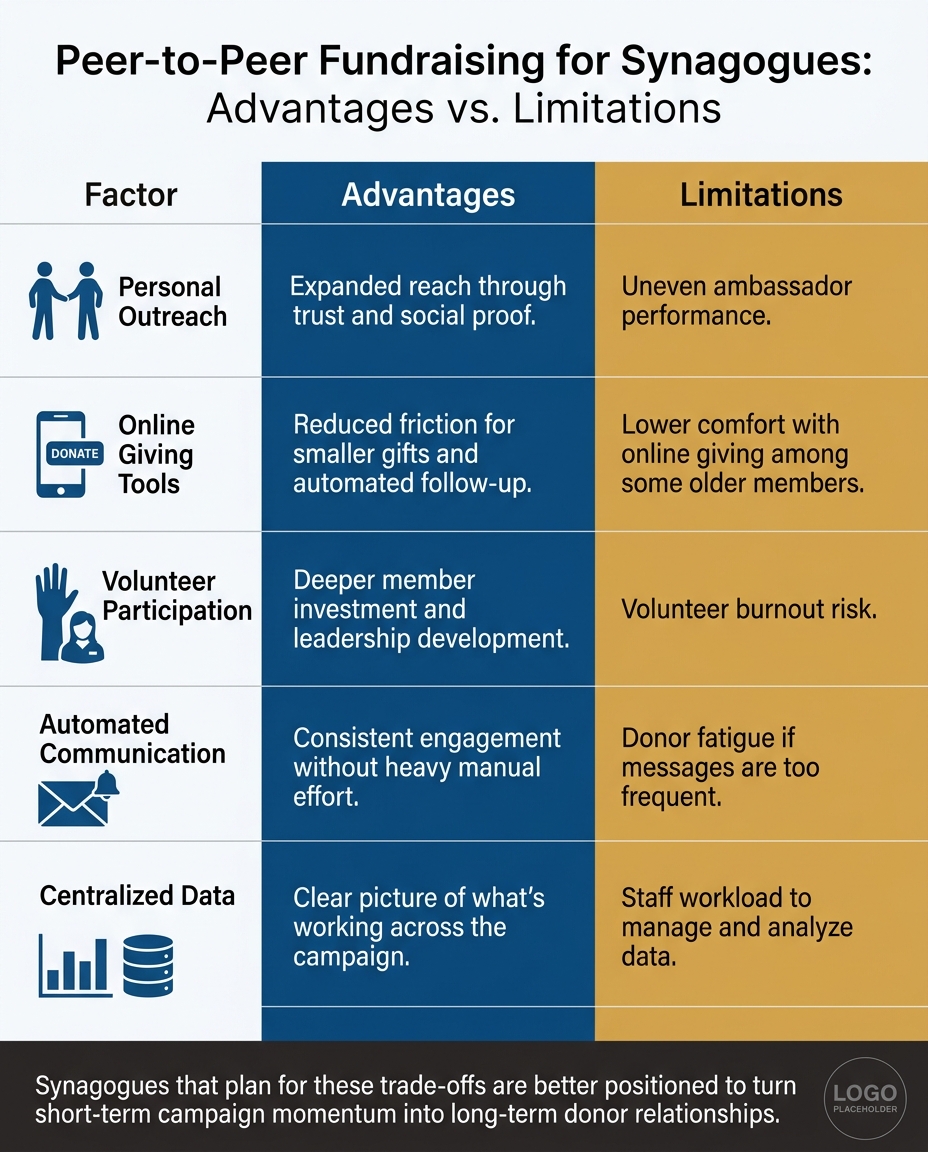
Peer-to-Peer Fundraising for Synagogues: Advantages vs. Limitations
Peer-to-Peer Fundraising for Synagogues: Advantages vs. Limitations
The examples above show a simple pattern: these campaigns tend to grow when trusted people make the ask and the donation process feels easy.
Peer-to-peer campaigns work because people respond to people they know. A message from a fellow congregant often feels more personal, which adds trust and social proof. That helps participation grow and can extend a synagogue’s reach beyond the usual donor circle. In synagogue communities, this often means campaigns spread faster when members invite other members to give.
There’s another upside too. Volunteers often feel more invested in the congregation’s future when they play a direct role in fundraising. That sense of ownership can lead to stronger involvement even after the campaign is over. And with digital tools, it’s easier to make small gifts, track responses, and handle follow-up without so much friction.
The same things that help these campaigns can also create problems if the setup is weak. One common issue is uneven ambassador performance. Some volunteers bring in strong results, while others struggle to get traction. Burnout can also set in, especially when too much work falls on a small group.
Synagogues that still depend on older legacy systems may run into manual tracking and admin bottlenecks. Follow-up matters just as much. If post-campaign outreach is weak, it becomes harder to turn first-time support into an ongoing relationship. That’s the bigger test: not just whether a campaign brings in one-time gifts, but whether it helps build donor ties the synagogue can return to later.
The table below sums up the main trade-offs.
| Factor Advantage Limitation | ||
|---|---|---|
| Personal outreach | Expanded reach through trust and social proof | Uneven ambassador performance |
| Online giving tools | Reduced friction for smaller gifts and automated follow-up | Lower comfort with online giving among some older members |
| Volunteer participation | Deeper member investment and leadership development | Volunteer burnout |
| Automated communication | Consistent engagement without heavy manual effort | Donor fatigue if messages are too frequent |
| Centralized data | Clear picture of what’s working across the campaign | Staff workload to manage and analyze the data |
Synagogues that plan for these limits have a better shot at keeping the campaign under control while turning short-term momentum into longer-term engagement.
A peer-to-peer campaign helps a synagogue grow only when the follow-up does more than say “thank you.” The big job starts after the campaign ends: turning first-time contacts into people who give again, show up again, and stay connected.
That’s why the numbers matter only if the synagogue uses them.
Each gift should be tied to the right household and the right campaign source. That keeps acknowledgments accurate and makes later outreach much easier. New contacts should also be grouped by source, gift size, and membership status so follow-up fits the person instead of feeling generic.
It also helps to track recurring gifts over time. That gives the synagogue a clear view of retention, not just one-time campaign results. Good reporting can also show which appeals, programs, or outreach messages brought in the most first-time donors. When leaders can see that, they’re in a much better spot to repeat what worked in the next campaign.
This process gets much simpler when records, communication, and reporting all live in one system.
Easyshul does more than organize donor records after a fundraiser. Its built-in peer-to-peer fundraising campaign software lets synagogues launch and manage campaigns within the same platform they already use for membership, finance, events, communications, and reporting.
Synagogues can invite members and supporters to participate as fundraisers, give them personal campaign pages to share with friends and family, and monitor donations and campaign progress in one place. This expands the campaign beyond the synagogue's own contact list while reducing the need to move information between a separate fundraising tool and the congregation's database.
Watch this short video to see Easyshul's peer-to-peer fundraising campaigns in action.
Because campaign activity connects with the synagogue's broader records and communications, staff can identify new donors, acknowledge gifts, and continue engaging supporters after the campaign. Members can also use Easyshul for self-service payments, event registration, and giving history.
That setup helps a synagogue carry campaign energy forward instead of letting it fade once the fundraiser ends. When people can stay involved without friction, repeat participation becomes much easier.
Peer-to-peer campaigns create the most value when synagogues treat them as the beginning of a longer engagement cycle, not a one-time push.
The main things to measure are:
Not just dollars raised.
Leaders who review those results after each campaign are in a better position to strengthen the next one.
Peer-to-peer campaigns help synagogues bring in new donors by reaching past the usual audience. Instead of relying only on the synagogue’s own channels, these campaigns tap into congregants’ personal networks.
That shift matters. Members become advocates who share the synagogue’s mission with friends, family, and other contacts. And because the message comes from someone people know, it often feels more personal and easier to trust.
With Easyshul's built-in peer-to-peer fundraising software, synagogues can create the campaign, equip members with personal fundraising pages, and keep donation tracking and communication in one place. That makes it simpler to reach new prospects, see which outreach is working, and turn first-time donors into steady supporters.
After a peer-to-peer campaign wraps up, synagogues need to watch three things closely: donation patterns, pledge follow-through, and how well their messages worked.
That means keeping an eye on incoming gifts and sending reminder messages when balances are still unpaid. A simple follow-up can make a big difference.
Leaders should also look at engagement data to see what landed best. Which programs got the most attention? Which outreach efforts brought people in? Those answers can help shape the next campaign and make it stronger.
Easyshul can keep all of this in one place, so no donor or member slips through the cracks.
Build small, focused teams instead of leaning on one overloaded group. Give clear responsibilities, like donor outreach, governance, or education, to people who know those areas well. That keeps the work from piling up on just a few shoulders.
Just as important, keep the campaign personal and grounded in shared values - not just a series of asks and follow-ups. Tools like Easyshul can help by centralizing and automating admin work, which cuts down on manual tasks and frees up staff and volunteers to spend more time building real community relationships.