.png?width=3750&height=938&name=Easyshul%20Logo%20(1).png)
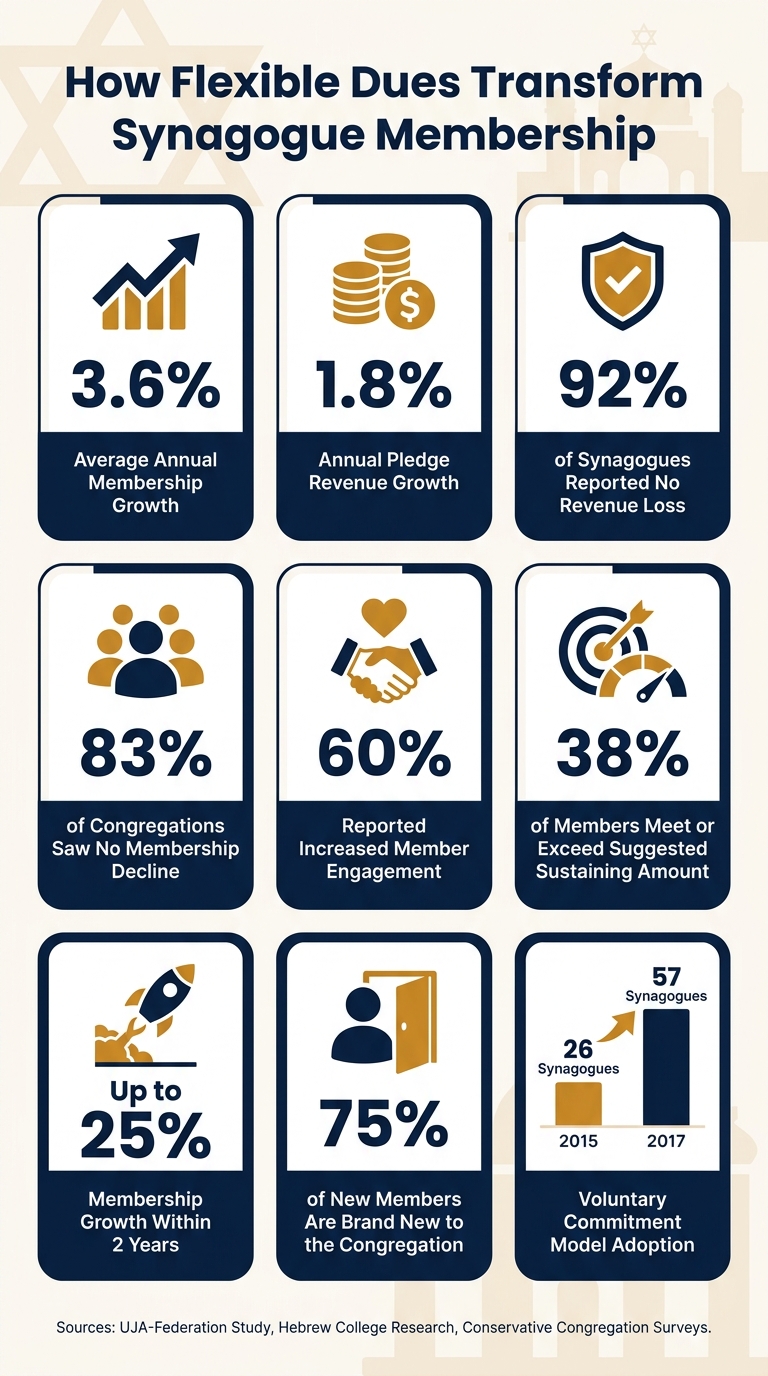
Flexible dues models are reshaping synagogue membership by allowing individuals to contribute amounts based on personal choice rather than fixed fees. This approach has helped many synagogues reverse declining membership trends, with an average annual growth of 3.6% in congregations that made the switch. These models also attract younger families, unaffiliated individuals, and former members, diversifying synagogue communities. However, financial contributions often lag behind membership growth, with only 38% of members meeting or exceeding the suggested sustaining amount.
Key takeaways:
- Membership Growth: Synagogues adopting flexible dues see steady increases, with some reporting up to 25% growth within two years.
- Revenue Stability: 92% of congregations reported no revenue loss after transitioning, though financial growth is slower than membership growth.
- Challenges: Under-pledging remains a concern, requiring clear communication and engagement to encourage higher contributions.
- Technology's Role: Tools like Easyshul help synagogues manage pledges, track finances, and improve transparency.
Flexible dues reframe synagogue membership as a relationship rather than a transaction, fostering stronger connections and broader participation. While challenges exist, effective systems and communication strategies can mitigate risks and sustain growth.
Flexible Dues Impact on Synagogue Growth: Key Stats
Flexible Dues Models in Synagogues
Types of Flexible Dues Models
Flexible dues models come in several forms, with one of the most common being the voluntary commitment model, often referred to as the "Gift of the Heart." In this approach, members decide their own contribution amounts. A related option is the sustaining amount model, which openly shares the synagogue's per-household operating costs and encourages members to contribute either above or below that suggested figure. For instance, Temple Beth Abraham in Tarrytown, NY, recommends an annual rate of $3,300.
Another approach is the progressive "fair share" model, where dues are calculated as a percentage of household income. Additionally, the community commitment model combines separate fees - such as religious school tuition - into a single voluntary pledge. Makom Solel Lakeside in Highland Park, Illinois, adopted this model during the 2021–2022 fiscal year under the guidance of Executive Director Holly Krakow. This change brought in 84 new member households in just one year, including 52 families with young children. As a result, Pre-K through 2nd-grade class sizes doubled, and the 3rd-grade class size tripled.
These flexible approaches illustrate the growing trend among synagogues to rethink traditional dues structures. But what drives this shift? Let’s explore the reasons behind these changes.
Why Synagogues Switch to Flexible Models
Synagogues are increasingly adopting flexible dues models to better reflect their community values and address financial challenges. These models also help eliminate the discomfort of fixed rates, which sometimes force members to request financial abatements. Allison Fine, former president of Temple Beth Abraham, explained the emotional toll of this traditional system:
"The idea of having to declare that you couldn't afford membership was humiliating and shaming to some members. It contradicted everything we are trying to accomplish as a welcoming congregation."
Younger generations, particularly Millennials, often view institutional obligations with skepticism. They are more likely to support communities where they feel a genuine connection. Flexible dues models reduce barriers to joining by framing membership as a personal commitment rather than a rigid fee. This shift in mindset has contributed to the growing popularity of voluntary commitment models, with the number of synagogues using them increasing from 26 in 2015 to 57 by 2017.
Limitations in Data Collection and Analysis
While flexible models show promise, research into their effectiveness has some notable gaps. Most studies focus on small-to-medium congregations, with 81% of participating synagogues having fewer than 500 member households. Larger congregations, or "mega-synagogues", remain underrepresented. For example, Congregation Emanu-El in San Francisco, which has 2,100 members, reverted to mandatory dues in 2009 after 13 years with a voluntary model. They cited significant disparities in contributions among members with similar financial means as a key issue.
Geographic representation in these studies is also uneven. A 2015 UJA-Federation study, for instance, excluded synagogues from New York City, Long Island, and Westchester, despite these areas having large Jewish populations. Additionally, many synagogues struggle to track financial data over time, making it difficult to assess long-term results. This highlights the growing importance of modern synagogue management platforms, which are better equipped to maintain accurate records and support informed decision-making.
sbb-itb-549ca3a
How Flexible Dues Affect Membership Growth
Membership Growth by the Numbers
Synagogues that transition to flexible dues models often experience steady membership growth. On average, congregations report a 3.6% annual increase in membership after implementing a voluntary dues system. While the yearly growth may seem modest, the cumulative effects are significant over time. In fact, 83% of congregations report no decline in membership, with many seeing notable surges - up to 25% - by the second year. A survey of Conservative congregations revealed that 35% saw membership growth after adopting the new model, while only 17% reported a decrease.
Changes in Member Demographics
Flexible dues models don’t just increase membership numbers - they also diversify the community. These systems are particularly effective at attracting young families, individuals who were previously unaffiliated, and former members who had left but are now returning.
Take Congregation Beth Shalom in Santa Clarita, CA, as an example. After shifting to a voluntary commitment model, the congregation doubled its size to 236 households between 2013 and 2017. Similarly, Scarsdale Synagogue welcomed 25 new families after making the same change. Research highlights that 75% of new members under flexible dues models are completely new to the congregation, while 25% are returning members who had been absent for at least three years. This approach also appeals to interfaith couples and lower-income families, who may feel more comfortable joining when financial barriers are reduced.
These demographic changes not only enrich the community but also lay the groundwork for deeper connections, which are essential for sustaining long-term growth.
What Drives Membership Growth
The key to the success of flexible dues lies in reframing membership as a relationship rather than a financial transaction. By eliminating the "pay-to-pray" perception, synagogues empower individuals to engage with the community on their own terms. This shift has a profound impact: 60% of congregations report increased overall engagement after adopting voluntary dues.
That said, initial contributions from members often fall short of covering per-household costs. To address this, synagogues use ongoing engagement strategies to encourage members to gradually increase their financial support, ensuring the model remains viable over time.
Financial Effects of Flexible Dues
Let’s dive into how adopting flexible dues impacts a synagogue’s financial health, especially after observing membership growth trends.
Revenue Changes After Adoption
Flexible dues have provided an unexpected level of financial stability for many congregations. A study of 57 congregations revealed that 92% experienced no revenue loss after transitioning to this model, with none reporting a drop in financial stability. However, the financial growth has been slower than membership growth. Membership increases by 3.6% annually, but pledge revenue only grows by 1.8% per year. This reflects that many new members contribute less than the per-household cost.
Temple Israel of Sharon in Massachusetts offers a clear example. Despite nine years under a voluntary dues model, Executive Director Benjamin Maron noted that overall dues income remained essentially flat. Membership grew steadily, but only 45% of members paid at or above the sustaining level - better than the national average of 38%, but still leaving over half of the congregation contributing below the break-even point. This highlights the financial risks tied to under-pledging.
Financial Risks and How to Manage Them
A key challenge with flexible dues is the tendency of new members to pledge below the actual cost of maintaining the synagogue. This can lead to stagnant revenue, even with growing membership. Currently, only 38% of members nationwide contribute at or above the sustaining level.
One way to address this is through clear communication. Synagogues must share the sustaining amount - the actual cost per household - with their members. By providing a transparent benchmark instead of an arbitrary fee, congregations can encourage more meaningful contributions. Rabbi Sanford Kopnick of Valley Temple emphasized this approach:
"We don't call it a bill, we call it a statement and a contribution."
Another strategy involves fostering a deeper sense of community responsibility. Congregations that move away from rigid billing cycles and focus on personal conversations about giving often see better results. Reintroducing the flexible dues model annually and framing contributions as part of a covenantal relationship can also help prevent revenue stagnation.
How Technology Supports Financial Management
Modern technology plays a vital role in managing the financial complexities of flexible dues. Research shows that many synagogues struggle to track financial data effectively, which can undermine the sustainability of this model. Rabbi Dan Judson, PhD, of Hebrew College Rabbinical School, highlighted this issue:
"Congregations struggle to adequately track their financial data. Better tracking and more data could allow them to more effectively sustain a financial change."
This is where tools like Easyshul come into play. Platforms like Easyshul provide real-time visibility into individual pledge levels, centralize membership and financial data, and integrate with accounting tools like QuickBooks and Sage. They also support donation tracking and online payments, offering synagogue administrators the clarity they need to identify and address potential revenue risks early. By combining technology with effective financial management, synagogues can achieve stability while continuing to grow their membership.
Best Practices for Rolling Out Flexible Dues
Leadership and Culture
When it comes to rolling out flexible dues, the mindset behind the change matters more than the financial model itself. Congregations that succeed in this transition move away from a transactional "pay-to-pray" approach and embrace a relational model. Here, financial contributions are seen as an expression of connection and belonging rather than just a fee.
The language used during this shift is crucial. For instance, replacing terms like "dues" with phrases such as "Community Commitment" or "Gift of the Heart" helps reframe contributions as acts of tzedakah (philanthropy) rather than obligatory payments. Allison Fine, a former president of Temple Beth Abraham in Tarrytown, NY, highlighted that requiring members to disclose financial hardship clashed with the congregation's goal of creating a welcoming community.
Gaining buy-in from leadership is another cornerstone of success. For example, Temple Emeth in Teaneck, NJ, addressed leadership concerns by securing "angel donors" - members who were financially able to cover any shortfalls during the transition. This safety net gave the board the confidence to move forward. By the time the new model was launched, over half of the congregation had already submitted their pledge forms. With a strong cultural foundation and evidence of steady membership growth, congregations can build the systems needed to sustain this model.
Systems and Tools You Need
Switching to a flexible dues structure introduces more financial complexity than a fixed model, making reliable systems essential. Congregations benefit greatly from centralized platforms that consolidate membership data, pledge levels, payment histories, and engagement metrics. Without such systems, siloed data can delay the identification of financial risks. Rabbi Dan Judson of Hebrew College Rabbinical School has noted that poor data management is a common reason flexible dues models falter.
A strong online payment system is equally important. Offering options like monthly contributions - such as $36 per month - can make participation more manageable, especially for younger members or families. Congregation B'nai Israel in Bridgeport, CT, incorporated this approach into their Impact Giving model, combining a $36/month base with a suggested $500 annual donation allocated to specific budget areas. These systems not only stabilize revenue but also encourage membership growth. Clear policies for handling pledge shortfalls, recalculating sustaining amounts, and following up with members are also key to maintaining financial stability.
Using Easyshul to Support the Transition
One tool that simplifies the transition to flexible dues is Easyshul. This platform is designed to handle the administrative challenges of flexible dues models. It tracks pledges, processes online payments, and monitors revenue trends, all in one place. Members can use user-friendly portals to review their pledge history, update payment methods, and make contributions whenever it suits them. Synagogue leaders benefit from real-time dashboards that provide a clear overview of pledge trends and potential cash flow issues, fostering the transparency needed for a successful voluntary giving model.
Easyshul also integrates with accounting tools like QuickBooks and Sage, ensuring smooth financial data flow without manual reconciliation. Its automated communication tools help keep members engaged, reinforcing the study's insight that maintaining a flexible dues program requires ongoing relationship-building rather than one-time appeals.
Conclusion: Key Findings and Next Steps
The research leaves little doubt: flexible dues work. Congregations that adopted this model saw an average annual membership growth of 3.6% and a 1.8% yearly increase in pledge revenue. Even more telling, 92% of synagogues that transitioned to flexible dues reported no loss in revenue. While these numbers may not seem dramatic, they point to steady and reliable growth.
But the benefits go beyond the financials. Around 60% of congregations reported increased member engagement after making the switch. This highlights an important truth: flexible dues send a powerful message that belonging takes precedence over financial contributions. However, these advantages come with their own set of challenges.
For example, new members often pledge below the sustaining level, making ongoing engagement in the second year just as critical as the initial rollout. Rabbi Dan Judson of Hebrew College points out that many congregations lack the systems to track financial data effectively, which can make it hard to spot and address issues early on. The solution? Better tools, clear communication, and a focus on re-engaging members annually.
As Rabbi Judson explains:
"Congregations struggle to adequately track their financial data. Better tracking and more data could allow them to more effectively sustain a financial change." - Rabbi Dan Judson, PhD, Hebrew College
This is where platforms like Easyshul come into play. Easyshul simplifies pledge tracking, automates member communication, and provides real-time revenue insights. By giving synagogue leaders the tools to manage a voluntary dues model effectively, it replaces uncertainty with confidence. The technology doesn’t replace relationships - it makes managing them at scale far more practical.
Looking ahead, future studies could benefit from longer observation periods and more consistent data collection across congregations. Still, the current findings are strong enough for synagogue leaders to take action. Flexible dues are no longer an experiment - they’re a proven approach, and the resources to support them are already available.
FAQs
How do flexible dues bring in new members?
Flexible dues make joining more accessible by eliminating rigid financial requirements and creating an inviting, inclusive atmosphere. Instead of fixed fees, members contribute what they can comfortably afford, fostering a greater sense of connection and community. This approach not only sidesteps awkward conversations about money but also resonates with younger families. As a result, congregations using this model see an average annual membership growth of 3.6%.
Will flexible dues reduce synagogue revenue?
Research indicates that adopting flexible or voluntary dues doesn't usually lead to a drop in synagogue revenue. In fact, many congregations report steady growth, with pledge revenue rising by an average of 1.8% to 4.4% annually, alongside an increase in membership. While new members might contribute less at first, most synagogues find their financial health improves over time. Tools like Easyshul play a key role in monitoring these financial shifts, helping maintain transparency as congregations adapt to new membership models.
How can we prevent under-pledging?
Avoiding under-pledging starts with building strong relationships, maintaining financial transparency, and clearly articulating the synagogue’s mission. To minimize the chances of members pledging less than the sustaining amount, it’s important to cultivate connections that go beyond their initial year of membership. Regularly highlight the voluntary giving model and its impact.
Easyshul plays a key role in supporting these efforts. It offers tools designed for member engagement, donation tracking, and transparent reporting. These features help leaders keep open, ongoing conversations about financial commitments, ensuring members feel informed and connected to the synagogue’s goals.