---
title: Re-engage Lapsed Synagogue Members
description: Re-engaging lapsed synagogue members requires personalized outreach, empathetic conversations, and consistent data-driven follow-up.
image: https://assets.seobotai.com/cdn-cgi/image/quality=75,w=1536,h=1024/easyshul.com/6a1b7dd05ded517781cb792e-1780189956264.jpg
---
[Skip to content](https://blog.easyshul.com/blog/reengaging-lapsed-synagogue-members-checklist#main-content)
.png?width=3750&height=938&name=Easyshul%20Logo%20(1).png)
Open main navigation
Close main navigation
- [Book a Demo](https://easyshul.com/form.html)
[Book a Demo](https://easyshul.com/form.html)
Jun 10, 2026, 2:22:35 AM
# Checklist for Re-engaging Lapsed Synagogue Members
[Easyshul](https://blog.easyshul.com/blog/author/easyshul)
Share: [facebook-f icon](http://www.facebook.com/share.php?u=https://blog.easyshul.com/blog/reengaging-lapsed-synagogue-members-checklist) [linkedin-in icon](http://www.linkedin.com/shareArticle?mini=true&url=https://blog.easyshul.com/blog/reengaging-lapsed-synagogue-members-checklist) [Twitter icon](https://twitter.com/intent/tweet?url=https://blog.easyshul.com/blog/reengaging-lapsed-synagogue-members-checklist) [envelope icon](mailto:?body=https://blog.easyshul.com/blog/reengaging-lapsed-synagogue-members-checklist)
**Did you know?** Nearly 50% of North American Jews leave their synagogue within 3–5 years of joining. Re-engaging these members isn’t about dues - it’s about showing care, understanding life transitions, and rebuilding connections.
Here’s a quick summary of how to reconnect effectively:
- **Define "lapsed members"**: Identify those who haven’t engaged in 6–12 months. Look for patterns like families disengaging after life events (e.g., bar mitzvahs).
- **Organize member data**: Update contact details and segment members by engagement history (e.g., High Holy Day attendees, empty nesters).
- **Personalized outreach**: Prioritize phone calls over mass emails. Tailor messages by referencing past involvement or life changes.
- **Empathy first**: Avoid discussing finances initially. Focus on open-ended questions like, “What would you like to see more of?”
- **Follow up consistently**: Log every interaction and aim for small daily outreach (5–10 contacts). Handwritten notes or texts can stand out.
- **Track progress**: Measure renewal rates, time to renew, and engagement trends. Use feedback to refine your approach.
**Tools like [Easyshul](https://easyshul.com/)** can simplify tracking, communication, and personalized outreach. Thoughtful re-engagement strengthens bonds and revitalizes your community.
Let’s dive into the steps to make this process manageable and effective.
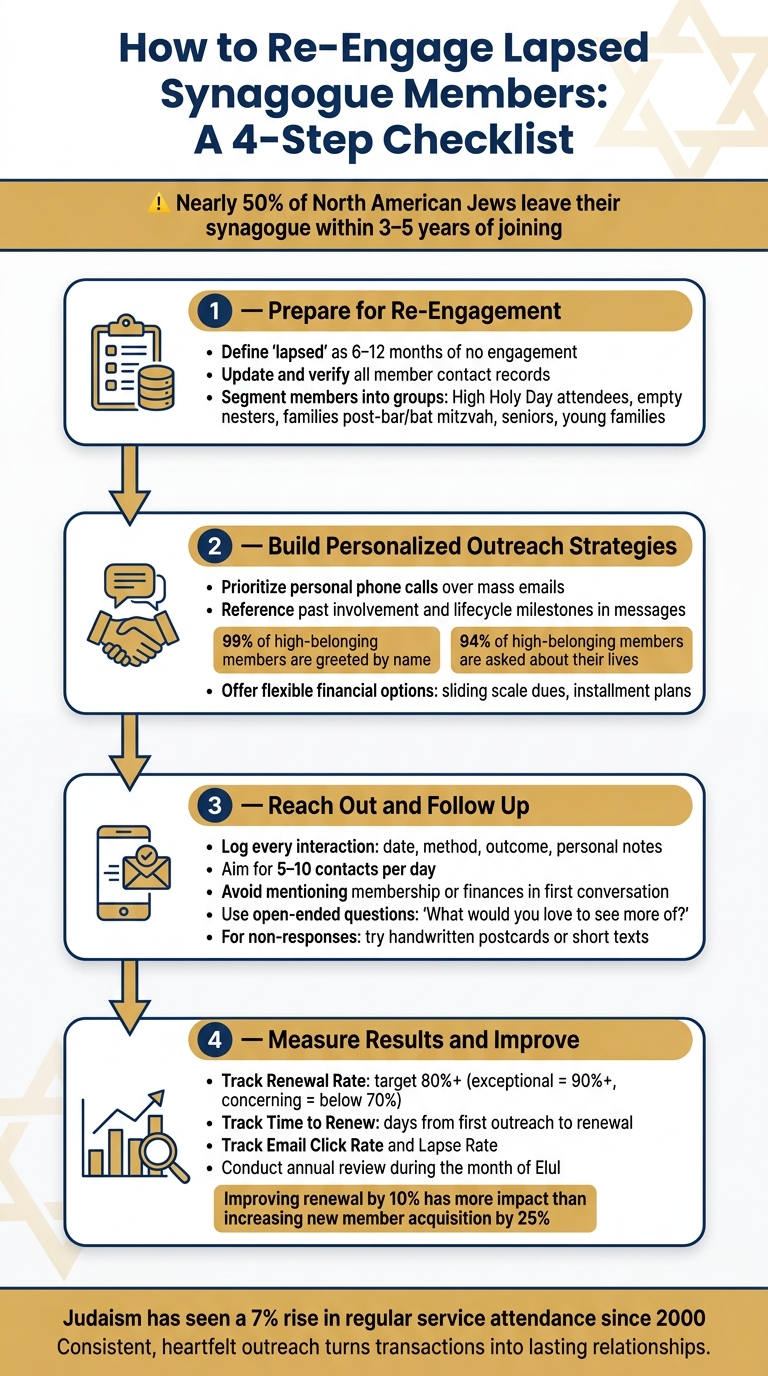
How to Re-Engage Lapsed Synagogue Members: A 4-Step Checklist
## Step 1: Preparing for Re-Engagement
Before reaching out, make sure your data is well-organized. Clear and up-to-date records allow for more meaningful and personal conversations. Once your records are in order, segment your members to create tailored engagement strategies.
### Setting Lapsed Membership Criteria
Start by defining what "lapsed" means for your congregation. This ensures a consistent approach to outreach. Typically, members who haven't engaged in any way - such as attending services, participating in events, volunteering, or contributing - over the last 6–12 months should be flagged. Pay attention to common lifecycle transitions, such as families disengaging after bar/bat mitzvah ceremonies or nursery school dropouts. Use measurable criteria to identify lapsed members clearly.
> "We are also actively watching retention metrics and engagement for our new members; accounts that have not been 'activated' in terms of engagement over any given period of time." - Jason Plotkin, Executive Director, Temple Israel
Don’t forget to check for members who may have missed their auto-renewal. This happens more often than you might think and can lead to unintentional lapses.
### Reviewing and Updating Member Data
After identifying lapsed members, confirm that your contact information is accurate. Outdated email addresses or phone numbers can derail your efforts before they even begin.
Make sure each record includes recent details, such as notes from past conversations, concerns shared by the member, family updates, or lifecycle events. For example, Jason Plotkin’s team at Temple Israel in West Bloomfield, Michigan - a congregation with 3,000 households - uses this method. They enrich member accounts with personalized notes to ensure every interaction feels thoughtful and informed.
Tools like [Easyshul](https://easyshul.com) simplify this process. With its membership CRM, staff can log interaction notes, track yahrzeit dates, and maintain family details, all in one place. This means you’ll have the context you need for every re-engagement conversation.
### Grouping Members by Profile
To make your outreach more effective, segment members based on their last known engagement. For instance, you might create groups for High Holy Day-only attendees, families whose children have aged out of youth programs, seniors with mobility challenges, or young families who have gone quiet. These segmented lists help you craft messages that address each group's specific needs and circumstances.
> "By utilizing data and analytics, synagogues can not only streamline their activities but also deepen their impact, creating a more vibrant, inclusive and engaged community." - Jason Plotkin, Executive Director, Temple Israel
Using [Easyshul](https://easyshul.com), you can tag and filter households by their engagement history or demographic profile. This allows you to build targeted outreach lists quickly and efficiently, saving time while improving the quality of your communication.
###### sbb-itb-549ca3a
## Step 2: Building Personalized Outreach Strategies
Now that you've identified your member segments, it’s time to decide *how* to connect with them and craft messages that resonate. Generic outreach won’t cut it - personalized communication is what truly grabs attention.
### Choosing the Right Communication Channels
Email may be easy, but it’s often overlooked due to inbox overload. On the other hand, personal phone calls stand out as the most effective way to re-engage, particularly with members who’ve been inactive for a while.
> "The email campaigns aren't working anyways... You'll need to start calling those folks - it's the only way it can happen." – Shulware
A great example is the **"Shanah Tovah" phone campaign**, which takes place during the month of Elul, just before the High Holidays. These calls are made by board members and trained volunteers - not just staff - and focus on offering warm holiday wishes rather than discussing dues. Hearing from a fellow community member feels far more personal than a call from the synagogue office. Aligning outreach with key times on the calendar, like Elul or the weeks following the High Holidays, adds an emotional touch to your message. Before making a call, review the member’s history in Easyshul to ensure your conversation is well-informed.
### Writing Personalized Messages
The key to effective outreach is making members feel valued, not pressured. Personalize your messages by including their name, referencing milestones or past involvement, and tailoring the tone based on lifecycle events. For example, consider whether they’ve recently become empty nesters, experienced a loss, or have children aging out of youth programs.
> "When you renew your membership, you're not just making a financial transaction - you're renewing your place in our sacred community. Your commitment breathes life into our shared spiritual home." – Shulware
This approach is backed by research on congregational belonging. For instance, **99% of members who feel a strong sense of belonging report being greeted by name**, while fewer than 15% of those with low belonging say the same. Similarly, 94% of high-belonging members say their fellow community members ask about their lives, compared to just 2% of those with low belonging. Personalized outreach reinforces the message that every member is an essential part of the community.
### Handling Financial Concerns
Financial challenges are a common reason for disengagement, so it’s important to address them head-on with sensitivity and understanding.
> "The approach and delicacy of that conversation is paramount to allowing donors who donate less money to feel equally as a stakeholder in the community." – Shulware
Start by offering **flexible financial options**, such as sliding scale dues, installment plans, or reduced-fee tiers for those who primarily join through livestream or hybrid services. Simplify the renewal process with easy-to-understand forms and multiple payment methods to prevent members from passively disengaging. When financial concerns come up, having a trained lay leader or board member handle the conversation can make it feel more personal and less transactional.
## Step 3: Reaching Out and Following Up
Now that you’ve crafted a personalized outreach strategy, it’s time to put it into action. The key here is persistence - consistent follow-ups transform a single attempt into a meaningful effort to reconnect.
### Logging Contact Attempts
Keeping track of every interaction is essential. Jason Plotkin, Executive Director of Temple Israel, explains it well:
> "We are populating data on both our members and non-members' accounts within the system in a manner comparable to the medical records at your doctor's office - the notes the physician reads before an appointment as a reminder of prior conversations, health issues and concerns or goals presented during past visits."
After each call, email, or text, log the details: the date, the method of contact, the outcome, and any personal notes about the member. This practice ensures you can pick up conversations without missing a beat. To avoid feeling overwhelmed, break your outreach list into smaller chunks - aim for **5–10 contacts per day**. These detailed records lay the groundwork for more personal and thoughtful interactions.
### Having Empathetic Conversations
The first conversation is all about reconnecting, not asking for dues. A good rule of thumb? **Avoid mentioning "membership" or finances** during the initial contact. Let the member bring those topics up if they wish. Instead, focus on open-ended questions like:
- What’s changed in your life recently?
- Is there anything we could do better as a community?
- What would you love to see more of in the coming year?
Often, people disengage due to life changes - divorce, job loss, or kids leaving home - rather than dissatisfaction. Acknowledging these transitions with empathy, and without judgment, shows that you care about them as individuals, not just as members. By recording these insights, you’ll be better equipped for future conversations, even with those who are harder to reach.
### Handling Non-Responses
Silence doesn’t always mean someone isn’t interested. As Rose Grech, Product Marketing Manager at [Rhythm](https://www.rhythmsoftware.com/), puts it:
> "Inactive members aren't gone; they're signaling where clarity or connection broke down."
If your calls and emails aren’t getting through, try switching things up. A handwritten postcard or a short text - like a “Happy New Year” message or a quick note about an event they might enjoy - can stand out more than yet another email in a cluttered inbox. After two or three attempts with no response, it’s okay to step back. A final note inviting them to reconnect when they’re ready is far more welcoming than repeated follow-ups that might feel pushy.
## Step 4: Measuring Results and Improving the Process
Once your outreach efforts are in motion, the next step is figuring out what's working - and what needs tweaking. Without tracking your results, you're essentially operating on guesswork.
### Tracking Re-Engagement Metrics
Certain metrics are essential for evaluating the success of your outreach. One of the most important is your **renewal rate**, which measures the percentage of lapsed members who return. A renewal rate above 80% is a strong indicator of healthy engagement, while rates of 90% or more are exceptional. On the other hand, rates below 70% suggest there may be deeper issues that need addressing.
Another key metric is **time to renew**, which tracks the days between your first outreach and when a member renews. If most members only renew after receiving a final notice, it might be time to revisit your initial messaging. Additionally, email engagement metrics, such as click rates, can help pinpoint areas for improvement in your outreach efforts.
> "Improving renewal by 10% often has a larger impact on an organization than increasing new member acquisition by 25%." - Matt Elliott, Communal
Tools like [Easyshul](https://easyshul.com) make it simple to monitor these metrics in one place. They allow you to track donation trends, outstanding balances, and membership renewal income without the hassle of juggling multiple spreadsheets.
| Metric | Metric Definition |
| --- | --- |
| **Renewal Rate** | Percentage of lapsed members who return |
| **Lapse Rate** | Percentage of members who don't return within 30–60 days |
| **Time to Renew** | Days between first outreach and renewal payment |
| **Email Click Rate** | Percentage of recipients who clicked the renewal link |
Another metric to keep an eye on is failed payments. Addressing these can help recover members who may have encountered technical issues during the renewal process. Together, these metrics provide a clear picture of where barriers might exist and how to overcome them.
### Collecting Feedback from Members
While metrics show the "what", follow-up conversations can uncover the "why." After your re-engagement efforts, consider sending a short survey or making follow-up calls to understand why some members lapsed. Was it financial strain, a lack of connection, or too many impersonal emails?
> "Having data is great, but the real key is the investment in both personnel and time in using it." - Jason Plotkin, Executive Director of Temple Israel
When financial concerns come up, approach these conversations with sensitivity. The goal is to make every member feel valued, regardless of their financial situation. Use their feedback to update member records and fine-tune your outreach strategies. These insights can help you adjust your approach and build stronger connections with your community.
### Reviewing the Checklist Each Year
To keep your strategy effective, schedule an **annual review** of your re-engagement process. The best time for this is during the month of Elul, when many organizations are already focused on renewal efforts.
During this review, analyze your metrics to identify what worked and what didn’t. Compare year-over-year data, such as attendance trends and renewal rates segmented by how long members have been with you. This will help you understand which communication channels are most effective. Revisiting your segmentation strategy ensures that both new and long-time members receive personalized outreach. It’s also a great opportunity to audit your membership database to remove duplicates and update contact information, ensuring your data remains accurate.
> "Renewal isn't a campaign. It's a process. Get the process right and the numbers follow." - Matt Elliott, Communal
Even small changes can make a big difference. Updating email templates, refining daily outreach strategies, and identifying member groups that need extra attention are all simple steps that can make your re-engagement efforts more effective over time.
## Conclusion: Building a Stronger Community
Re-engaging lapsed members isn’t just about increasing attendance - it’s about showing them how much they matter to the community. When outreach is consistent and heartfelt, it transforms the connection from a simple transaction into a meaningful relationship.
The numbers back this up. Thoughtful, targeted re-engagement efforts lead to measurable growth, proving that steady commitment delivers results far beyond what seasonal efforts can achieve.
For example, **Judaism has experienced a 7% rise in regular service attendance since 2000**, even as many other U.S. religions face declines. This shows that people still crave connection and belonging, reinforcing the importance of well-organized, intentional outreach.
Tools like [Easyshul](https://easyshul.com) make it easier to track member activity, manage communications, and keep data organized - key components for effective engagement. The checklist provided here offers a solid framework, but it’s your ongoing dedication that truly strengthens bonds. Together, these strategies and tools can help you build relationships that last.
## FAQs
### Who should we label as “lapsed” members?
Members can often be labeled as lapsed when they begin to show signs of disengagement - like not attending services since the High Holidays. It’s also important to consider major life changes, such as shifts in marital status or becoming an empty-nester, as these transitions can make members more likely to drift away. Platforms like Easyshul, which offer lifecycle triggers, can be incredibly useful for spotting these at-risk members. These tools allow for targeted and effective outreach to re-engage them.
### What’s the best first message to send or say?
The first message to members should feel **personal** and highlight their unique relationship with the synagogue. Skip generic templates - mention their past involvement or specific connections to the community. Show genuine interest by focusing on what they might need or hope for in the coming year. For long-time or highly involved members, a **personal phone call** from a staff member or leader can be the most meaningful way to reestablish that connection.
### How do we track if re-engagement is working?
To gauge how well your re-engagement strategies are working, keep an eye on essential metrics within your management platform. These include **event attendance**, **email open and click-through rates**, and **activity within the member portal**. Additionally, quick polls can be a great way to gather direct feedback from members. This data helps pinpoint who’s actively involved, who might need additional outreach, and where your programming could be improved. By doing this, you can make sure your efforts and resources are directed toward building stronger, more meaningful connections.
## Related posts
[](https://blog.easyshul.com/blog/synagogue-management-software-vs-spreadsheets-comparison)
## [Synagogue Management Software vs Spreadsheets: Which Wins?](https://blog.easyshul.com/blog/synagogue-management-software-vs-spreadsheets-comparison)
[Easyshul](https://blog.easyshul.com/blog/author/easyshul)
Feb 25, 2026, 10:44:34 PM
Spreadsheets may work for very small congregations, but growing synagogues need management software...
[Read more](https://blog.easyshul.com/blog/synagogue-management-software-vs-spreadsheets-comparison)
[](https://blog.easyshul.com/blog/synagogue-services-in-house-vs-outsourced)
## [In-House vs. Outsourced Services for Synagogues](https://blog.easyshul.com/blog/synagogue-services-in-house-vs-outsourced)
[Easyshul](https://blog.easyshul.com/blog/author/easyshul)
May 6, 2026, 7:27:30 AM
In-house and outsourced staffing each offer distinct benefits for synagogues. In-house teams...
[Read more](https://blog.easyshul.com/blog/synagogue-services-in-house-vs-outsourced)
[](https://blog.easyshul.com/blog/synagogue-database-essential-features)
## [7 Essential Features Every Synagogue Database Should Have](https://blog.easyshul.com/blog/synagogue-database-essential-features)
[Easyshul](https://blog.easyshul.com/blog/author/easyshul)
Feb 26, 2026, 11:05:55 PM
Seven essential features for synagogue databases: member records, donation tracking, events & High...
[Read more](https://blog.easyshul.com/blog/synagogue-database-essential-features)
[linkedin-in icon](https://www.linkedin.com/company/easyshul) [Follow us on Facebook](https://easyshul.com/)
---
447 Broadway Suite #672, New York, NY 10013, United States
[Shalom@easyshul.com](mailto:Shalom@easyshul.com) (866) 215-5950
Copyright © 2026, Easyshul Inc
```json
{
"@context" : "https://schema.org",
"@type" : "BlogPosting",
"author" : {
"@type" : "Person",
"name" : "Easyshul",
"url" : "https://blog.easyshul.com/blog/author/easyshul"
},
"dateModified" : "2026-06-10T06:22:35.539Z",
"datePublished" : "2026-06-10T06:22:35.000Z",
"headline" : "Re-engage Lapsed Synagogue Members",
"image" : [ "https://assets.seobotai.com/cdn-cgi/image/quality=75,w=1536,h=1024/easyshul.com/6a1b7dd05ded517781cb792e-1780189956264.jpg" ],
"mainEntityOfPage" : {
"@id" : "https://blog.easyshul.com/blog/reengaging-lapsed-synagogue-members-checklist",
"@type" : "WebPage"
},
"publisher" : {
"@type" : "Organization",
"logo" : {
"@type" : "ImageObject",
"url" : "https://blog.easyshul.com/hubfs/Untitled%20design%20(96).png"
},
"name" : "Easyshul Inc"
}
}
```
```json
{
"@context" : "https://schema.org",
"@type" : "FAQPage",
"mainEntity" : [ {
"@type" : "Question",
"acceptedAnswer" : {
"@type" : "Answer",
"text" : "Members can often be labeled as lapsed when they begin to show signs of disengagement - like not attending services since the High Holidays. It’s also important to consider major life changes, such as shifts in marital status or becoming an empty-nester, as these transitions can make members more likely to drift away. Platforms like Easyshul, which offer lifecycle triggers, can be incredibly useful for spotting these at-risk members. These tools allow for targeted and effective outreach to re-engage them.
"
},
"name" : "Who should we label as “lapsed” members?"
}, {
"@type" : "Question",
"acceptedAnswer" : {
"@type" : "Answer",
"text" : "The first message to members should feel personal and highlight their unique relationship with the synagogue. Skip generic templates - mention their past involvement or specific connections to the community. Show genuine interest by focusing on what they might need or hope for in the coming year. For long-time or highly involved members, a personal phone call from a staff member or leader can be the most meaningful way to reestablish that connection.
"
},
"name" : "What’s the best first message to send or say?"
}, {
"@type" : "Question",
"acceptedAnswer" : {
"@type" : "Answer",
"text" : "To gauge how well your re-engagement strategies are working, keep an eye on essential metrics within your management platform. These include event attendance, email open and click-through rates, and activity within the member portal. Additionally, quick polls can be a great way to gather direct feedback from members. This data helps pinpoint who’s actively involved, who might need additional outreach, and where your programming could be improved. By doing this, you can make sure your efforts and resources are directed toward building stronger, more meaningful connections.
"
},
"name" : "How do we track if re-engagement is working?"
} ]
}
```