.png?width=3750&height=938&name=Easyshul%20Logo%20(1).png)
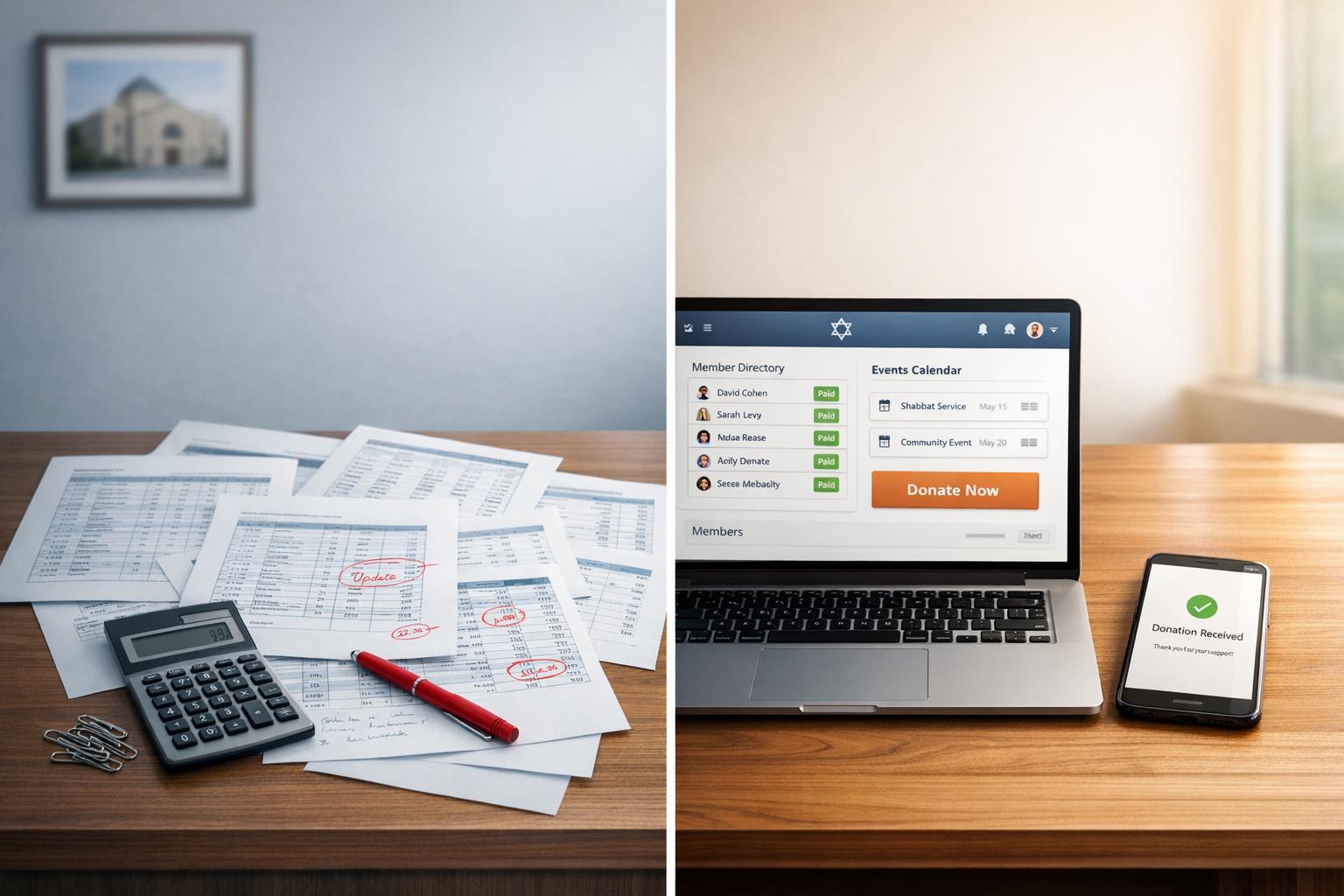
Spreadsheets may work for very small congregations, but growing synagogues need management software...
When it comes to synagogue membership dues, there's no one-size-fits-all solution. Synagogues are exploring different payment models to balance financial stability with member accessibility. Here are five common approaches:
- Fixed Dues: Members pay set fees, often based on demographic categories (e.g., age, family size). While predictable for budgeting, the system can feel rigid and may deter those uncomfortable with requesting financial adjustments.
- Fair Share: Contributions are tied to a percentage of income (typically 1.5%-2.0%), offering a proportional and private approach. However, income variability can make budgeting harder for synagogues.
- Voluntary Commitment: Members choose their contribution amount, creating a flexible and welcoming environment. This model relies on strong member engagement to ensure consistent revenue.
- Tiered Membership: Offers pricing tiers based on services or life stages, such as young families or online-only memberships. It’s clear and structured but requires more administrative effort.
- Mixed Model: Combines fixed dues with flexible options, such as discounts or tiered pricing, to address diverse member needs while maintaining financial predictability.
Each model has trade-offs, and synagogues must consider their community's values, financial realities, and administrative capacity when selecting or transitioning to a new system. Transparency, communication, and a focus on member engagement are key to success.
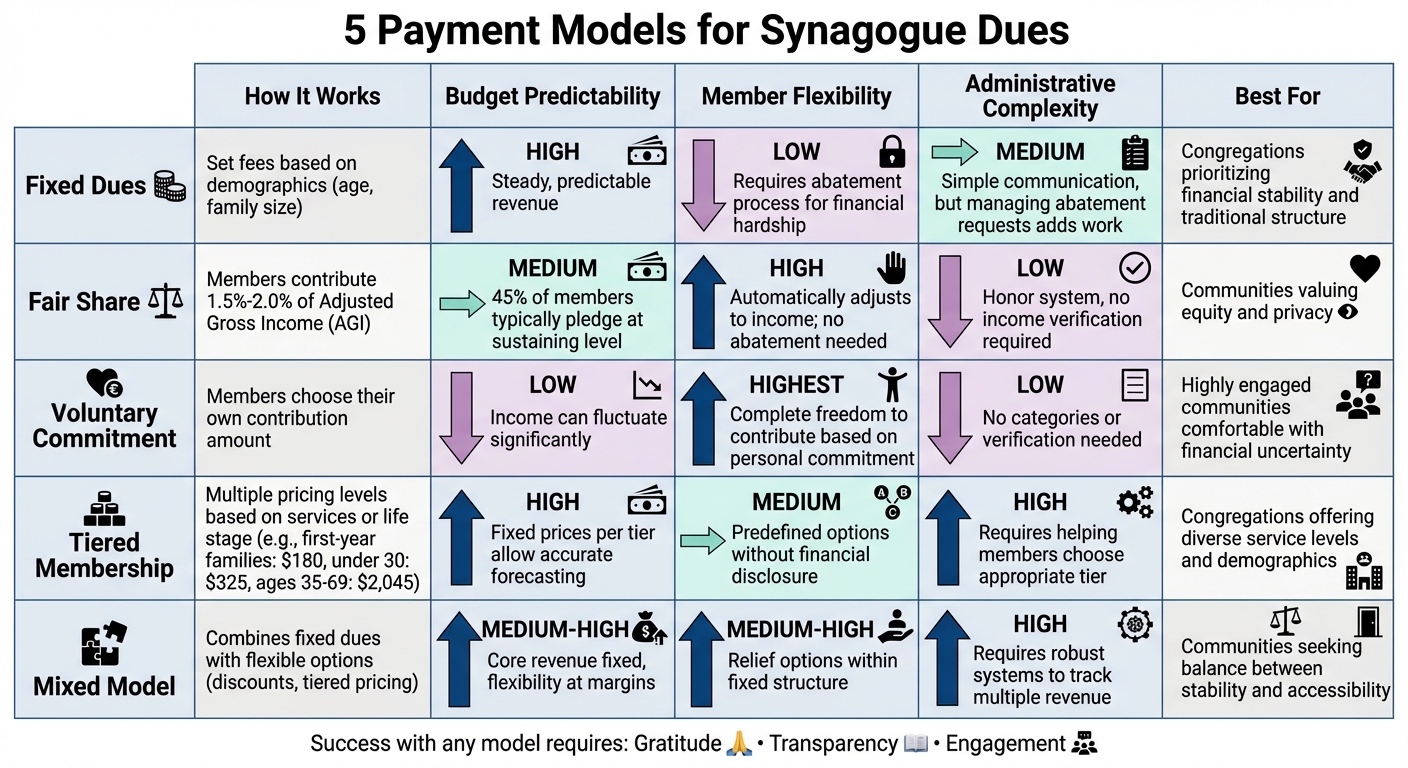
Comparison of 5 Synagogue Dues Payment Models
1. Fixed Dues
Fixed dues have long been a familiar approach for synagogues, offering a structured way to manage membership contributions. This model assigns specific fees based on member demographics. For instance, a synagogue might charge different rates for singles under 35, families with children, and seniors over 65. Historically, this replaced the earlier system where wealthy donors supported congregations in return for perks like preferred seating. The fixed dues model introduced a more equitable structure, ensuring that everyone in the same category pays the same amount for equal access.
Budget Predictability for the Synagogue
One major advantage of fixed dues is the financial predictability it provides. Synagogues can rely on steady revenue streams to plan for staffing, maintenance, and programming needs. However, adjustments to these fees often require formal membership votes, which can slow down necessary changes.
Flexibility for Members with Varying Financial Capacities
This model applies uniform fees within each category, regardless of individual financial situations. To address this, many synagogues have a dues-abatement process, offering discounts to members who cannot afford the standard rates. In some cases, these applications are simplified by removing the need for proof of financial hardship. Still, this process can create barriers. As Rabbi Esther L. Lederman and Amy Asin point out:
Congregations with fixed dues models will have to accept that some people will not join because they aren't willing to ask for a reduction.
Administrative Complexity and Ease of Implementation
From an administrative standpoint, fixed dues are straightforward to communicate since fees are clearly tied to member categories. However, managing abatement requests and keeping classifications updated can be challenging. To help members understand the value of their contributions, many synagogues use tools like one-page infographics to show how funds are allocated for staffing, building upkeep, and programming.
Member Engagement and Inclusivity
Inclusivity remains a concern with fixed dues, particularly for lower-income households. The abatement process can feel stigmatizing, potentially discouraging some from joining. Rabbi Esther L. Lederman and Amy Asin suggest that leaders examine whether these processes create barriers and explore reframing dues as philanthropic contributions instead.
Up next: a look at the Fair Share model, which aims to address some of these challenges.
sbb-itb-549ca3a
2. Fair Share
The Fair Share model asks members to contribute a fixed percentage of their Adjusted Gross Income (AGI), usually between 1.5% and 2.0%. This eliminates the need for abatement reviews and ensures privacy. Unlike category-based dues systems, this approach ties contributions directly to income, creating a more proportional and equitable structure.
Tailoring Contributions to Income Levels
By linking contributions to income, this model naturally adjusts for members' financial capacities. Those with higher earnings contribute more, while those with lower incomes pay less. Linda S. Boxer, Membership Chair at Temple Beth Tzedek, highlights the benefits:
We no longer have a dues review committee because we don't need one. No embarrassing questions. No need to disclose your finances.
To balance this flexibility, many congregations set a minimum contribution to ensure everyone participates and a maximum cap to avoid overburdening high-income households. This setup reduces financial stress while maintaining fairness and dignity.
Financial Stability for Synagogues
Fair Share also helps congregations plan their budgets. Synagogues calculate a "sustaining share" by dividing the total budget by the number of households. For example, Beth Chaim noted that 45% of its members pledged at or above this level, which supported steady operations and membership growth.
However, this model can introduce some unpredictability. To address potential shortfalls during the transition, some synagogues establish a guarantee fund, backed by donors, to stabilize finances in the early years.
Simplifying Administration
The honor system reduces administrative complexity by removing the need for income verification. Instead, the focus shifts to transparent communication about how funds are used. Synagogues often provide clear, concise breakdowns - like graphics or one-page summaries - to show how contributions support staff, facilities, and programs. To ensure financial targets are met, pledges are typically gathered before the fiscal year begins, allowing time to adjust budgets if needed.
Building Community and Shared Responsibility
This model changes the dynamic from a transactional fee system to a partnership built on shared responsibility. Contributions are framed as tzedakah (philanthropy), fostering a sense of gratitude and mutual investment.
3. Voluntary Commitment
This model takes a fresh approach by focusing on mutual respect and generosity within the community, moving away from rigid financial structures.
The Voluntary Commitment model allows members to decide their contributions based on their personal sense of commitment. This shifts the concept of dues into the realm of tzedakah, or charitable giving. As the Union for Reform Judaism puts it:
"In this model, people are asked to pay what they think is fair, given their participation and commitment to the community."
This method not only reimagines how dues are structured but also accommodates a wider range of financial situations among members.
Flexibility for Members with Different Financial Needs
One of the key benefits of this model is its removal of the often uncomfortable process of applying for reduced dues. Members no longer have to provide proof of financial hardship or request discounts. Instead, everyone starts on equal footing, operating on an honor system. This approach is especially welcoming to those who may feel hesitant about joining due to financial concerns. The Union for Reform Judaism emphasizes that fairness in this model is defined by willingness to contribute, not by strict financial requirements.
To guide members, congregations usually provide a suggested sustaining amount that reflects the cost of maintaining the community. However, members are free to give more or less based on their circumstances.
Strengthening Engagement and Inclusion
With voluntary contributions as the foundation, synagogues must focus on creating meaningful connections and demonstrating value. Members are more likely to support organizations where they can see the tangible impact of their contributions. This encourages congregations to be transparent about how funds are used. Many now use visual tools like charts or summaries to show how donations support staff, facilities, and programs.
This model also fosters inclusivity, as it prioritizes participation over financial ability. By inviting members to contribute at a level they feel comfortable with, it broadens access to the community.
Budget Challenges for the Synagogue
While this approach promotes inclusivity and engagement, it introduces a challenge: income can fluctuate. Predicting revenue becomes more complex, as even affluent members might contribute less if they feel less connected or engaged.
To manage this uncertainty, many congregations establish a temporary guarantee fund. This fund, supported by specific donors, helps cover potential financial gaps during the early years of the transition. However, this model requires careful financial planning, as its success hinges on strong member involvement and consistent contributions.
4. Tiered Membership
The Tiered Membership model offers various payment levels, tailored to the services members use or their specific life stage. Instead of a single, uniform fee, this structure allows families to select an option that aligns with their needs - whether that’s full access to religious education and pastoral care or a more limited online-only membership. This approach helps align financial commitments with individual circumstances while also promoting clear communication and predictable budgeting.
Options for Members with Different Financial Needs
One of the key benefits of this model is how it removes the burden from lower-income members to justify their financial situation. Traditional fixed dues often require members to disclose sensitive financial details, a process some have described as "repulsive". Tiered membership eliminates this issue by offering predefined pricing options. For instance, Temple Emanu-El in Marblehead, Massachusetts, implemented a system with clear tiers: first-year families paid $180, families under 30 paid $325, and those aged 35–69 paid $2,045. This transparency allows members to choose a tier without revealing personal finances. Many synagogues also include tiers specifically designed for young adults, singles, or online-only members.
Financial Stability for Synagogues
Tiered membership also brings financial predictability, which is harder to achieve with voluntary contribution models. Since each tier has a fixed price, synagogues can more accurately forecast annual income based on membership distribution. This is especially important as two-thirds of surveyed Reform congregations anticipated budget deficits in their upcoming fiscal year. Reliable revenue helps support the administrative and engagement efforts necessary for managing a tiered system.
Administrative Considerations
While tiered membership offers flexibility, it also requires more administrative effort. Rabbi Esther L. Lederman and Amy Asin highlight this challenge:
Moving to a tiered system requires helping congregants understand which tier is right for them.
To manage this complexity, synagogues need effective membership systems and automated invoicing to handle multiple tiers efficiently.
Strengthening Member Engagement
This model also fosters a more member-centric approach. When members pay for specific services, synagogues are encouraged to demonstrate the value of each tier. Many now provide visual breakdowns showing how funds are allocated to staff, facilities, and programs, which adds a layer of transparency. Additionally, the inclusion of online-only tiers expands participation, making membership accessible to those with limited mobility or who live outside the local area.
5. Mixed Model
The Mixed Model combines fixed dues with flexible elements, providing a steady revenue base while accommodating individual member needs. This hybrid strategy not only ensures financial stability but also allows for more personalized member benefits.
Budget Predictability for the Synagogue
One of the main strengths of the Mixed Model is its ability to maintain financial stability by selecting specific revenue streams to remain fixed. For instance, many synagogues charge a set tuition for religious school, even if general membership dues are more flexible. This ensures that essential educational costs are consistently met. To address potential gaps during transitions, synagogues often establish a small guarantee fund.
Flexibility for Members with Varying Financial Capacities
This model also introduces flexibility by offering relief options within a primarily fixed structure. The Union for Reform Judaism highlights:
Congregations with fixed dues offer relief that is consistent with a voluntary commitment model or a fair share model.
This means members can access reduced rates through simplified procedures. Synagogues can also implement demographic-specific tiers, such as discounts for young adults or online-only participants, making membership more accessible to a broader audience. However, this flexibility requires robust administrative systems to ensure smooth operations.
Administrative Complexity and Ease of Implementation
Managing a Mixed Model demands efficient tools for tracking diverse revenue streams. Professional bookkeeping systems are essential for generating detailed reports, handling tiered structures, and managing incentives like early payment discounts.
Member Engagement and Inclusivity
The Mixed Model supports financial stability while fostering deeper connections with members. Success in this approach hinges on three key elements: gratitude, transparency, and engagement. By framing all payments as acts of philanthropic tzedakah rather than mere obligations, synagogues can cultivate a more positive relationship with their members. Transparent communication - such as clear, visual summaries showing how funds are allocated to staff, facilities, and programs - can inspire greater voluntary contributions. As the Union for Reform Judaism notes:
People are no longer as likely to support or join Jewish organizations out of obligation; they need to see value and impact.
How to Implement Different Payment Models
Switching to a new payment model requires thoughtful planning and clear communication. Leaders need to choose a model that aligns with their values and principles of fairness. As Rabbi Esther L. Lederman and Amy Asin emphasize:
Switching dues models is not a quick fix to a revenue problem for your congregation. It requires planning and work to bring the congregation along with you.
This shift sets the foundation for engaging members effectively and ensuring the tools and processes are in place for a seamless transition.
Start by engaging members early to highlight the value and impact of their contributions. This is particularly important for voluntary or fair share systems. Use clear, visually engaging reports - like infographics or one-pagers - to show how funds are allocated across staff, maintenance, and programs. As Lederman and Asin explain:
People are likely to give more if they know how money is being spent.
Administrative tools are essential for managing this transition. Platforms like Easyshul (https://easyshul.com) support a variety of payment models with features such as a dedicated membership renewal module that supports multiple-dues models, batch billing, personalized payment links, and member portals. By integrating with accounting tools like QuickBooks and Sage, these systems ensure accurate tracking of dues, whether they are fixed, voluntary, or tiered.
To minimize financial risks, consider creating a guarantee fund to address any initial revenue shortfalls. Simplifying abatement processes - such as removing invasive "proof of need" requirements - can also make the system more accessible and welcoming.
Finally, framing contributions as acts of tzedakah fosters a positive, philanthropic culture within the congregation. Automated thank-you letters and receipts can reinforce this mindset, encouraging members to remain engaged and generous. This approach ties back to the broader goal of adapting synagogue dues systems to better meet the diverse needs of their members.
Conclusion
Selecting the best payment model for your congregation depends on understanding your community's values, administrative abilities, and comfort with financial risks. Each model has its strengths: fixed dues provide consistency, fair share and voluntary commitment models emphasize inclusivity, tiered membership offers structured options, and mixed models combine the advantages of multiple approaches. This guide offers a foundation to help your congregation decide which model aligns with its unique needs.
Focusing on accessibility and member participation is key. Members need to perceive real value in their contributions rather than feeling obligated to give. As Amy Asin puts it:
People are no longer as likely to support or join Jewish organizations out of obligation; they need to see value and impact.
Streamlining dues-abatement processes can also make your community more welcoming and encourage broader involvement.
Ultimately, success comes down to three essential elements: Gratitude, Transparency, and Engagement. Share clear financial reports so members understand how their contributions are used. Involve them actively in congregational life to reinforce the value of their support. And always show heartfelt appreciation for every donation, no matter the size.
To help implement these principles, tools like Easyshul (https://easyshul.com) simplify managing diverse payment systems. Features such as batch billing, personalized payment links, and integration with QuickBooks and Sage make it easier to maintain clarity and efficiency, fostering a stronger and more inclusive community.
Whether your congregation uses fixed, fair share, voluntary, tiered, or mixed models, clarity and a thoughtful approach make all the difference. Before considering a switch to address revenue challenges, evaluate whether improving transparency and engagement within your current system could solve the problem. If a change is necessary, setting up a guarantee fund can help manage financial risks during the transition. Treating all payments as acts of tzedakah - a form of giving rooted in justice and kindness - can cultivate a positive and philanthropic culture. With the right payment model, tools, and mindset, your congregation can achieve both financial stability and a deeper sense of community.
FAQs
Which dues model best fits our synagogue’s budget and culture?
When choosing a dues model for your community, it’s essential to weigh your values against your financial needs. Traditional fixed dues offer steady and predictable revenue, which can help maintain financial stability. However, this approach might pose challenges for members facing financial difficulties.
On the other hand, flexible models - like pay-what-you-can or tiered options - can make membership more accessible by accommodating a wider range of financial situations. These models prioritize inclusivity and can foster a stronger sense of belonging.
Ultimately, the best choice depends on what your synagogue values most. Does financial security take precedence, or is inclusivity the bigger priority? Engaging your members in this conversation can help ensure the chosen model reflects the needs and values of your community.
How can we switch dues models without losing revenue?
Switching your dues model can seem risky, but a well-planned approach can help you make the shift without sacrificing income. One way to do this is by offering flexible or hybrid options. These might include:
- Fixed dues: A consistent rate that’s easy to budget for.
- Pay-what-you-can: A more inclusive option that allows members to contribute based on their financial situation.
- Tiered structures: Different levels of membership at varying price points.
The key here is communication. Be upfront about the benefits of the new model and how it supports both the members and the organization. Transparency builds trust and helps members feel more comfortable with the change.
Additionally, offering adaptable payment methods can make a big difference. Tools like online payment systems and member portals not only simplify the process but also provide members with the flexibility to manage their payments easily. This convenience can go a long way in retaining members and ensuring steady revenue during the transition.
What’s the easiest way to manage tiered or flexible dues payments?
The simplest approach is to adopt a tiered or pay-what-you-can model, letting members choose a payment level that aligns with their financial circumstances. Tiered systems categorize members based on factors like income or demographics, which helps simplify dues management. Using a platform such as Easyshul can make this process even smoother by streamlining payment tracking and processing, ensuring that handling flexible or tiered dues is both efficient and hassle-free.