.png?width=3750&height=938&name=Easyshul%20Logo%20(1).png)
Synagogues often struggle with keeping members engaged long-term, with nearly half leaving within...
Renewal season is a critical time for synagogues. It's not just about collecting fees - it's about reinforcing the connection members feel to your community. Here’s what you need to know:
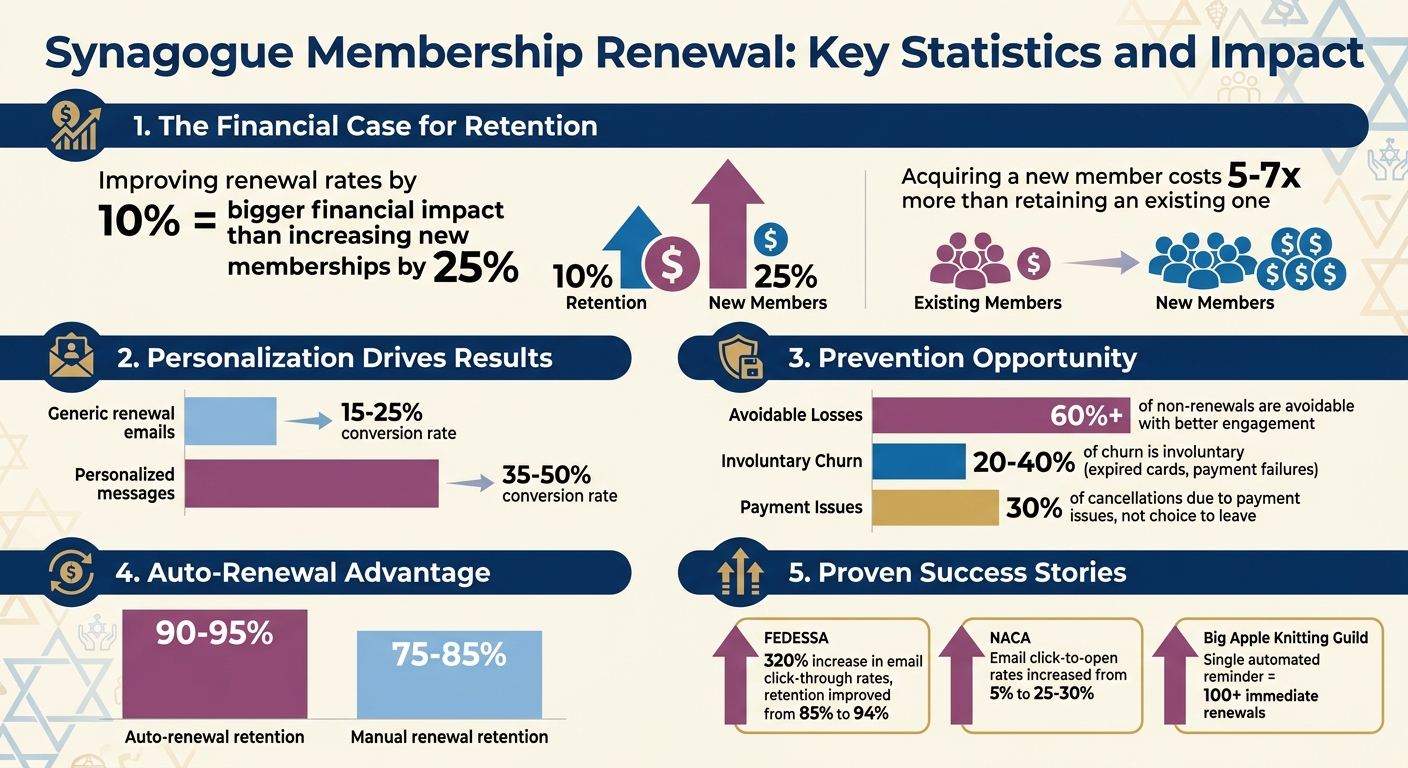
- Retention Matters: Improving renewal rates by 10% can have a bigger financial impact than increasing new memberships by 25%.
- Why Members Leave: Most non-renewals happen because members forget or find the process too complicated.
- Personalization Works: Tailored outreach can boost renewal rates from 15–25% to 35–50%.
- Events Drive Engagement: In-person gatherings and targeted events strengthen connections and encourage renewals.
- Technology Simplifies: Modern membership platforms automate reminders, payments, and engagement tracking, reducing administrative burdens.
- Flexibility Helps: Offering payment plans, sliding scales, and financial assistance ensures inclusivity.
Synagogue Membership Renewal Statistics and Impact
Personalized Outreach: Connecting with Members Individually
Generic renewal emails typically convert at a rate of 15–25%, but personalized messages that make members feel recognized can boost conversion rates to an impressive 35–50%. When your outreach connects with what truly matters to each individual, it’s not just about dues - it’s about reminding them why they belong.
Identifying Member Types
Members engage with your synagogue for different reasons. Some are motivated by community impact, wanting to see their membership support initiatives like youth education and cultural programs. Others are social connectors, drawn to potlucks, outings, and shared experiences. Then there are those who value ritual heritage or stand out for their dedication to volunteerism.
To understand these differences, track data like attendance, email engagement, and member portal activity. You can also use quick, focused polls to gather insights. For instance, asking one simple question every couple of weeks can create detailed member profiles without overwhelming anyone.
Here’s a real-world example: FEDESSA, a European trade association, used bi-weekly polls to better understand its members. This strategy led to a 320% increase in email click-through rates and improved member retention from 85% to 94%. Similarly, the National Association of Campus Activities tracked member logins and content access, which raised their email click-to-open rates from 5% to 25–30%. These cases highlight how tailored engagement can lead to meaningful results.
Once you’ve identified clear member profiles, the next step is crafting messages that speak directly to each group’s interests and values.
Writing Targeted Messages
Personalized outreach during renewal season can strengthen members’ commitment by addressing their specific motivations. Whether it’s emphasizing community impact, promoting upcoming social events, or highlighting the importance of sustaining spiritual traditions, tailor your communication to what resonates with each member.
Personalization is more than just using someone’s first name. Include meaningful details, like how often they attended events or the savings they’ve enjoyed as members, to show their unique value. Start your renewal campaign 90 days before memberships expire with a "Year in Review" summary. Follow up with 4–5 targeted messages, adding personal phone calls for high-value members and SMS alerts as deadlines approach. Timing matters too - send emails mid-morning on Tuesdays through Thursdays to increase the chances they’ll be noticed. Synagogues achieving renewal rates of 80% or higher often rely on phone outreach as part of their strategy.
"By tailoring messages to each personality, you can deliver communications that resonate deeply." - Shulware
Consider the success of the Big Apple Knitting Guild, a 400-member organization. They sent a single, well-timed automated reminder to members with expiring memberships, resulting in over 100 immediate renewals. When your outreach is timely and relevant, members are more likely to act.
sbb-itb-549ca3a
Using Events to Encourage Renewals
Hosting targeted events is a powerful way to reignite members' interest in renewing their memberships. It aligns perfectly with the goal of fostering deeper engagement. Interestingly, 64% of professional and trade association members say networking is their primary reason for joining. Plus, attending in-person events is one of the strongest predictors that a member will renew.
The timing and type of event can make all the difference. Mid-renewal networking events, early renewal celebrations, educational "Lunch and Learn" sessions, and small, regular gatherings help build connections while reinforcing the ongoing value of membership.
Planning Member-Focused Events
Events work best when tailored to your members' preferences. For example:
- Socially inclined members might enjoy potlucks or group outings.
- Those who value traditions may appreciate holiday-themed workshops.
- Volunteer or community-focused groups could benefit from family education days or recognition for service projects.
Adding interactive elements can also boost participation. Take The Delegate Wranglers' "Nearly Christmas Party" in September 2025 as an example. They used an attendee app with pre-event challenges and quizzes, which led to 50–75% of participants engaging with the app's leaderboards before the event even started. For virtual events, consider tools like live polls, breakout groups, and active moderation to ensure remote attendees feel just as involved as those attending in person.
Another effective strategy? Offer "early-bird" perks to encourage renewals. These could include exclusive access to certain events, discounted registration fees, or VIP invitations for early renewers. Also, segmenting event invitations based on members' interests or location can make the experience feel more personal and relevant.
Recognizing and Thanking Members
Small gestures go a long way in making members feel valued. Simple actions like handwritten notes, newsletter shout-outs, or small tokens can significantly boost engagement. In fact, members who receive regular, small acknowledgments are 8x more engaged than those who only receive annual recognition.
Events are an excellent platform for celebrating membership milestones. Whether it's marking 1, 5, or 10 years of membership, you can use digital badges, certificates, or public shout-outs to show appreciation. One professional association saw its five-year retention rate jump from 74% to 83% after revamping its recognition program. Similarly, a nonprofit increased its volunteer retention rate from 45% to 60% by introducing an annual volunteer appreciation awards night.
"Recognition works best when it taps into both personal pride and community visibility." - Nikki Massadi, EventsAir
Public recognition can be powerful, but always get explicit consent first. Personal touches, like a video message or a social media spotlight, often have a deeper emotional impact than generic giveaways. The goal is to make each member feel genuinely appreciated and seen.
These event-driven strategies work hand-in-hand with the technological and financial approaches discussed next, creating a well-rounded plan to encourage renewals.
Simplifying Renewals with Technology
Outdated systems can lead to errors, missed payments, and forgetfulness among members. Modern membership management platforms address these issues by automating the entire renewal process, making it easier for both organizations and members to stay on track.
How Membership Management Platforms Help
Automation is the key to resolving inefficiencies, and modern platforms deliver just that. For example, Easyshul streamlines recurring and batch billing, allowing synagogues to invoice large groups or specific segments instantly. Members benefit from self-service portals, where they can log in to settle balances, update contact information, and manage their renewals independently. This reduces the administrative workload significantly.
The platform's centralized CRM brings all member data into one interface, eliminating the need for juggling multiple disconnected systems. It also syncs member data automatically across education, events, and finance modules, minimizing the risk of manual errors. Renee Delafranconi, Executive Director at Temple Emanu El, shared her experience:
"The migration was seamless for us. Easyshul's onboarding process was wonderful - we felt fully supported every step of the way. The system was simple to learn and truly user-friendly".
Built-in communication tools further simplify the process by automating reminders for payments, membership milestones, and lifecycle events via email and SMS. Personalized payment links included in statement emails allow members to settle balances instantly. Additionally, the system generates and sends tax reports and receipts with just one click. Financial integrations with tools like QuickBooks and Sage ensure that membership data aligns accurately with accounting records.
These integrations not only make renewals smoother but also strengthen member engagement by connecting communication, finance, and event platforms seamlessly.
Monitoring Engagement with Data
Beyond automation, data-driven insights play a critical role in improving renewal strategies. Analytics tools help identify members at risk of not renewing, enabling staff to take proactive steps. Considering that acquiring a new member costs 5 to 7 times more than retaining an existing one, early intervention is essential. Studies show that over 60% of non-renewals can be avoided with better engagement and automation.
Keep an eye on red flags like no portal logins for over 60 days, repeated declines of event invitations, or sudden drops in activity. Involuntary churn - memberships lapsing due to expired credit cards or failed payments - accounts for 20–40% of total churn. To combat this, use data to identify credit cards set to expire within 90 days and launch automated "Pre-Expiry" email and SMS campaigns to encourage members to update their payment details.
Members who use auto-renewal features are far more likely to stay engaged, with retention rates of 90–95%, compared to 75–85% for manual renewals. Tracking email engagement can also refine outreach strategies by revealing what resonates most with members. As the Memberlytic Team wisely states:
"Your renewal rate is the single most important number in your membership organisation. It determines whether you are building on a growing foundation or constantly refilling a leaking bucket".
Making Membership Financially Accessible
Financial challenges shouldn't stand in the way of someone maintaining their membership. A flexible dues model ensures everyone feels like a valued part of the community. Synagogues adopting these approaches have seen membership increase by 3.6% and dues revenue grow by 1.8%.
Providing Flexible Payment Options
Offering alternative payment methods can make a big difference in reducing financial strain while keeping members engaged. For instance, monthly or quarterly installment plans can make dues more manageable, mirroring how people budget for services like streaming platforms or gym memberships. Sliding scale dues based on income or life stage - whether for young professionals, families, or retirees - can also help members find a payment level that works for them. For those facing temporary financial hardship, having a clear and respectful financial assistance process in place, along with options like volunteering in exchange for dues, can provide meaningful support.
Tools like Easyshul simplify this process by allowing synagogues to set up custom payment schedules, automate installment processing, and manage various membership tiers - all from a single system. Members can even choose payment dates that fit their cash flow, which reduces administrative headaches and ensures dignity is maintained.
You might also consider offering early-bird discounts of 10–15% for members who renew 30–60 days early. Multi-year commitments could be incentivized with savings of 10–17% for those who prepay for two or three years. Automated payment options are another way to encourage consistent engagement and improve retention.
Discussing Finances with Sensitivity
Conversations about money can be delicate, but approaching them with care builds trust and shows members they’re supported during tough times. The way you frame these discussions is key. Instead of focusing on the transaction, emphasize the spiritual and communal value of membership. Renewal can be presented as a chance to reaffirm one’s connection to the community.
When addressing payment challenges, personal phone calls are far more effective than automated emails. These calls allow for empathetic, private discussions about financial assistance. Use positive, solution-oriented language - like saying "we had trouble processing" instead of "your payment was declined" - to keep the conversation respectful. Before asking for renewal, consider sending a "Year in Review" summary that highlights everything the member has participated in, from events and classes to community programs. This helps them see the impact of their contributions.
Payment failures are often unintentional. In fact, about 30% of membership cancellations happen because of expired cards or other payment issues, not because someone chooses to leave. To prevent this, flag credit cards that will expire within 90 days and send friendly reminders to update payment details. This proactive approach can avoid unnecessary disruptions.
Conclusion
Renewal season doesn’t have to feel overwhelming. By combining personalized outreach, member-centered events, smart technology, and flexible financial options, you can turn what might feel like a routine task into a chance to strengthen relationships and foster a deeper sense of community.
The stats back this up: keeping current members is 5 to 7 times cheaper than bringing in new ones. Plus, improving your renewal rate by just 10% can have a larger financial payoff than boosting new member sign-ups by 25%. Even more striking, over 60% of non-renewals are avoidable with better engagement strategies and systems.
Platforms like Easyshul take care of the repetitive tasks - automated reminders, flexible payment plans, and engagement tracking - so your team can focus on what matters most: connecting personally with your members. Auto-renewal options clearly show the impact of reducing friction, with retention rates hitting 90–95% compared to 75–85% for manual renewals. These efficiencies allow your staff and volunteers to invest their time in building meaningful relationships.
"Renewal isn't a campaign. It's a process. Get the process right and the numbers follow." - Matt Elliott, Communal
Every interaction - whether it’s a reminder, a phone call, or a payment option - is a chance to show members they’re valued, not just as donors but as integral members of your sacred community. When you treat renewal as an ongoing relationship rather than a one-time event, you create engagement that endures far beyond a single membership cycle.
FAQs
When should we start our renewal outreach?
Start reaching out to members well before their renewal date to make the process seamless and improve retention rates. Many experts suggest treating renewal planning as an ongoing effort throughout the year. The key is to focus on early engagement and consistently highlight the value of membership. Starting several months ahead allows you to build trust, clearly communicate benefits, and minimize the risk of last-minute renewals falling through.
What should we personalize beyond a member’s name?
To make your communication more engaging, go beyond simply addressing a member by name. Tailor your messages to reflect their interests, past interactions, and preferences. For instance, you could mention their involvement in previous events, highlight their contributions, or touch on the specific reasons they might value renewing their membership. These thoughtful, personal details can strengthen relationships and inspire loyalty.
How do we prevent renewals from failing due to payment issues?
To reduce the chances of failed renewals due to payment problems, it’s a good idea to send recurring payment reminders before each billing cycle. This gives members a chance to update their payment information in advance. Another effective approach is using tokenized payments, which securely handle expired or invalid cards, making the process smoother. On top of that, having a solid recovery strategy in place can address common issues like expired cards or insufficient funds, helping to lower the risk of failed transactions and unintended cancellations.